
The Monday Blues
By: Katherine Gould, Curator of History Objects & Fine Art
Dear reader, I hope you don’t mind, but this is not going to be a thinky-thoughts kind of blog today. Usually a collections blog would be organized around a particular object or subject, or related to an exhibition we’re featuring. But I want to take a different approach. Blue is my favorite color, so I’m going to highlight some blue-tiful artifacts in my collection and tell you what I know about them. Okay?
Let’s start with this blue-ty! It’s a ceramic pitcher from 1888 celebrating the centennial of Cincinnati’s founding. It was made by the Rookwood Pottery Company and features relief images of the seal of the State of Ohio on one side with the date 1788, and the seal of the City of Cincinnati and the date 1888 on the other.

Rookwood Pottery was founded in 1880 by artist and businesswoman Maria Longworth Nichols (1849-1932), granddaughter of wealthy vintner and real estate speculator, Nicholas Longworth. Known for their iconic glazes, they received the gold medal for ceramics at the Expo Universelle in Paris in 1889. Having achieved success and prosperity, the firm opened their large factory atop Mount Adams in 1892 where they continued operating until production ceased in 1967. The Rookwood brand was revived in the mid-2000s and production of these iconic Cincinnati-made ceramics resumed.
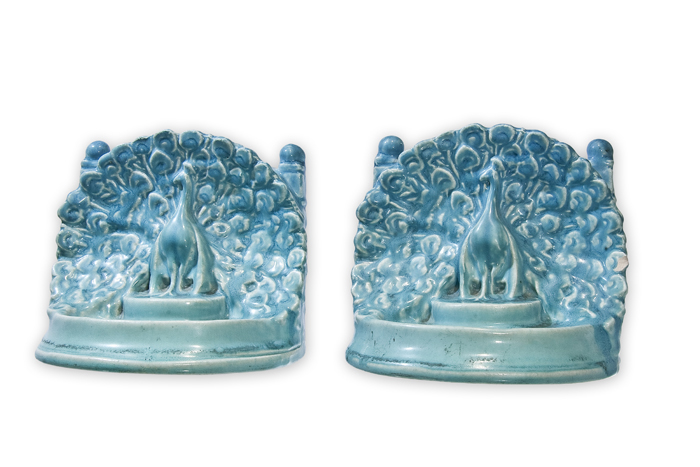
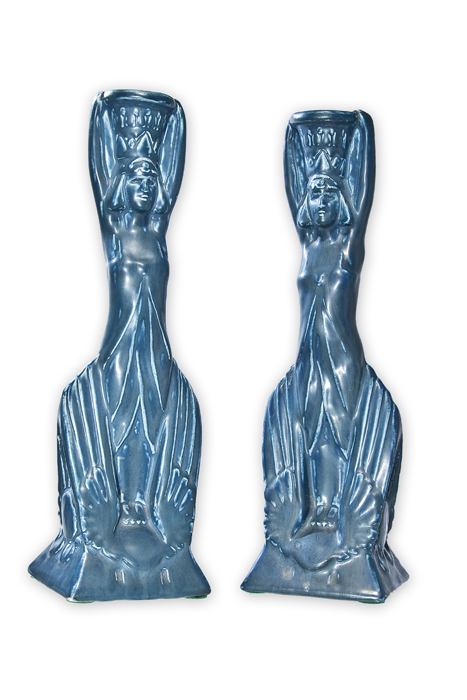
These proud as a peacock bookends and sphinx candlestick holders are also from Rookwood. The bookends were made in 1920 by artist William Purcell McDonald (1864-1931). He was born in Cincinnati, trained at the Cincinnati Art Academy, and joined Rookwood in 1882 as a painter and sculptor. He remained with the company until 1931. In fact he was with Rookwood for so long, his daughter Margaret Helen McDonald started working under him in 1913. We have six pieces in total by McDonald, including two other sets of bookends. The Egyptian-themed candle holders were also made in 1920 and were most likely designed by Ernest Bruce Haswell (1889-1965).
And one final Rookwood piece (they were very good at blue!) is this ashtray made for the Huenefeld Company in 1947 on the occasion of their 75th anniversary. Established in Cincinnati in 1872 by Prussian immigrant Ernst Henry Huenefeld (1838-1931), the company was well known for their BOSS selection of oven ranges, stoves, heaters, furnaces, and other household appliances. We have quite a few of those in the collection, but alas, none are blue. Huenefeld’s significant innovation came in 1909 when Ernst designed the first glass-door oven. [One of which is on display in the Made in Cincinnati exhibit at the museum]. This invention allowed cooks to monitor their culinary creations without opening the oven door and letting all the heat escape. Huenefeld moved their manufacturing from Pearl Street in downtown Cincinnati to the Camp Washington neighborhood in 1904 and continued manufacturing until 1966 when the company was sold.
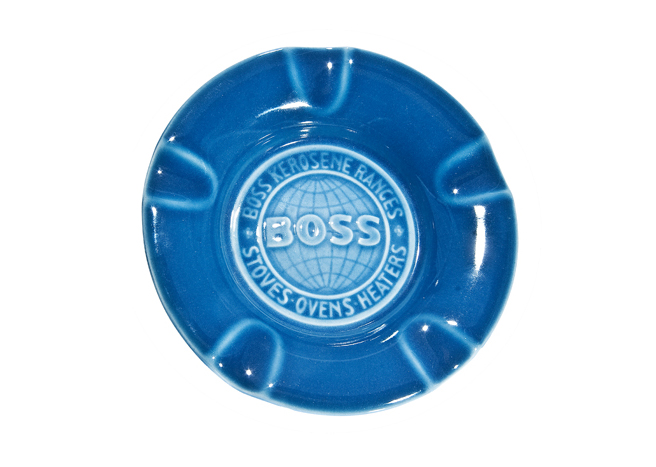
As a curator, I find ashtrays and other smoking accessories like this fascinating from a material culture perspective because of how quickly they’ve vanished from our everyday lives. Ashtrays were once seen as a necessity and, as a child of the ‘70s and ‘80s, I can attest to the fact that they were everywhere: beautifully designed ashtray stands prominently displayed in our homes; armrest ashtrays in our cars (and airplane seats!); and branded merchandise like cheap aluminum ashtrays on fast food restaurant tables or corporate gifts, like this one, in our offices. But with our changing attitudes toward cigarette smoking, and the declining rates of those engaging in the habit, these once ubiquitous objects are now mostly gone from sight. And I doubt grade school kids today are making ashtrays for mom and dad in art class like I did once upon a time (painted blue, of course).
This bluebird beauty is a circa 1876 relish dish, designed so that the tail of the bird can be used as a handle. It was made by the Hemingray Glass Company of Cincinnati and Covington. Julius Proeger was issued design patent number 8,942 on February 1, 1876, for “Design for Glass Dishes” in bird shape, and describes the upper surface as being “ornamented in bas-relief, indicating feathers.” The museum’s collection includes 12 identical Hemingray bird dishes in clear glass, opaque white, pale pink, blue, amber, and light blue.
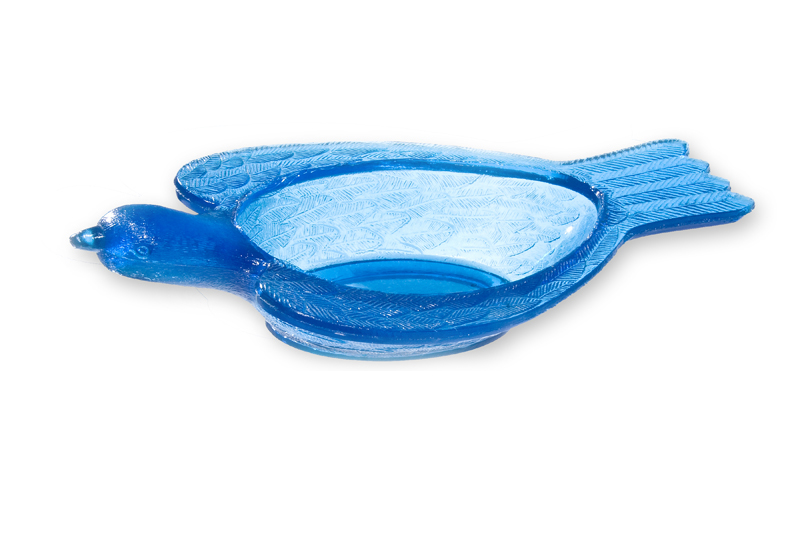
The Hemingray Glass Company was established in Cincinnati circa 1848 by Ralph and Anthony Gray and Samuel J. and Robert Hemingray, located on Hammond Street near the Ohio River. Around 1851 the company moved to Covington, Kentucky but by 1860 was located back in Cincinnati at 20 East 2nd Street. By 1864 they were known as Hemingray Brothers and Company, manufacturers of flint and green glassware and in 1870 the firm incorporated as the Hemingray Glass Company and were located at 64 Walnut Street in Cincinnati.
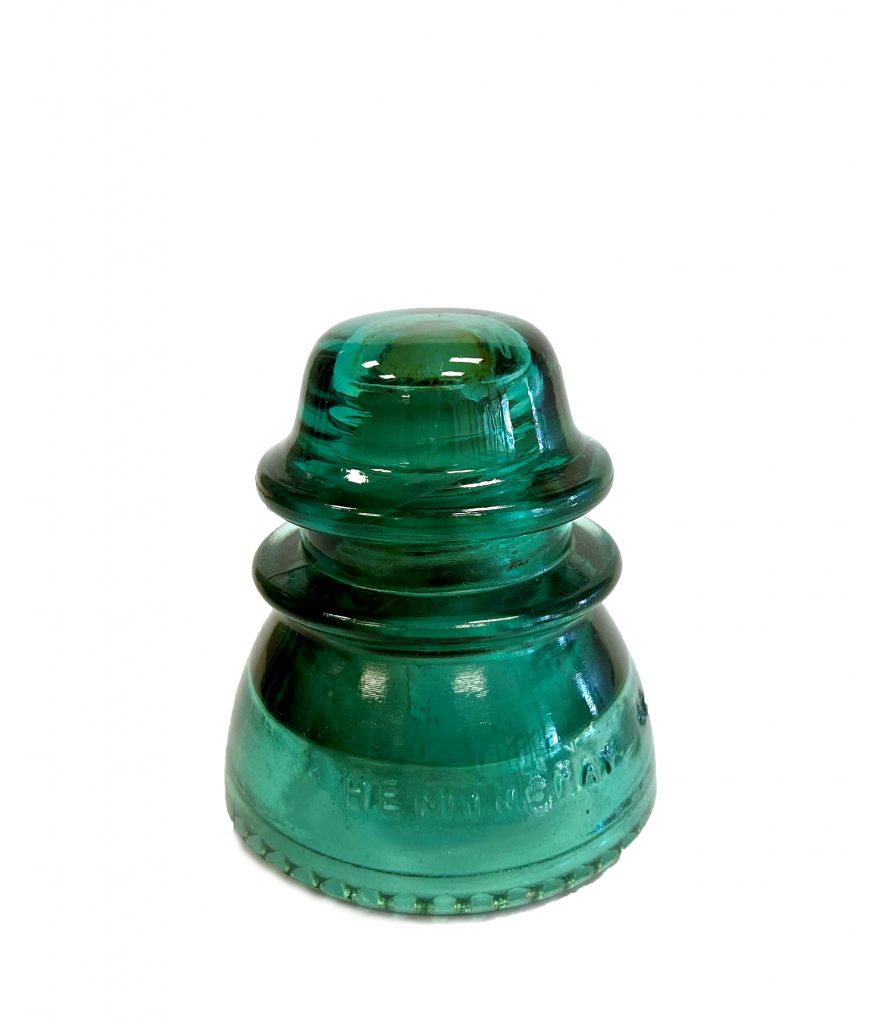
Hemingray is best known for their telegraph pin insulators, which are also blue! (The ones in the Museum’s collection are in the teal-turquoise family, but that counts.) In 1881 they received a patent (242,825) for a glass-press for the manufacture of insulators or other articles of glassware to form an internal screw-thread. And in 1893, they received a patent (496,625) for a useful improvement for a glass insulator for telegraph wires. They also produced bottles, fruit jars, dishes, and tumblers, etc. They had factories in Cincinnati and Covington, but their main production facility was located in Muncie, Indiana. In 1933, the company was purchased by Owens-Illinois Glass Company and the Muncie facility closed in 1972.
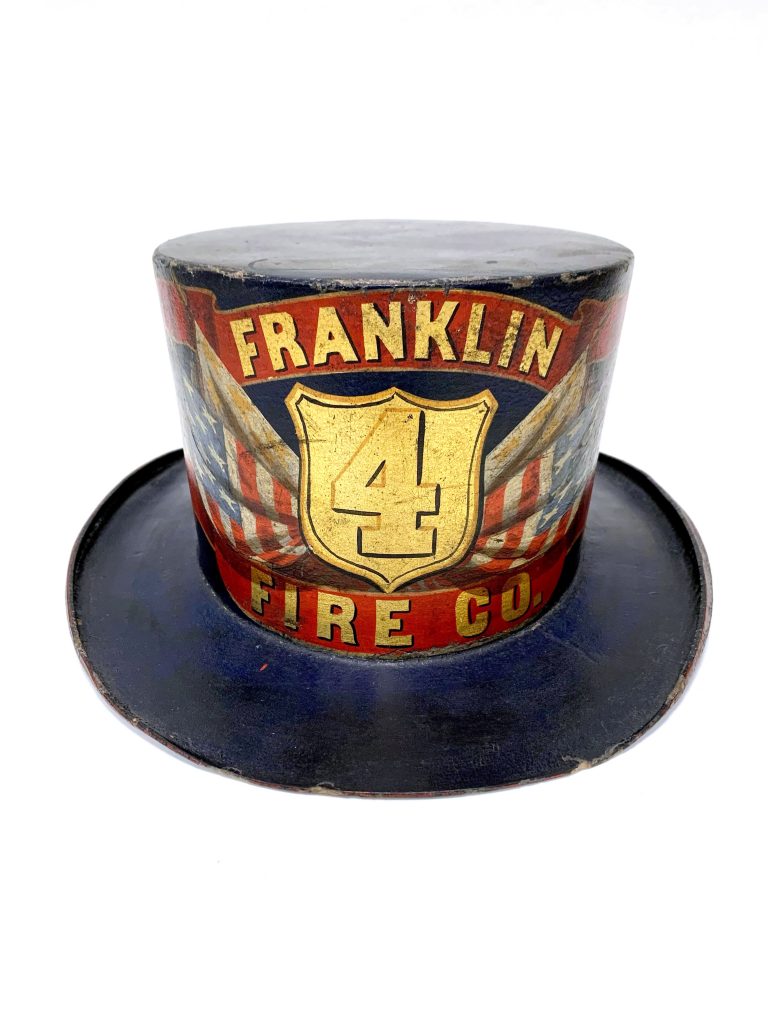
Moving away from glass and ceramics, this dark blue pressed-felt fireman’s parade hat is one of my favorite objects in the collection. It’s one of three painted parade hats donated in 1958 by the Ohio Mechanics Institute. It provides evidence of a trend by some volunteer fire fighters of wearing hats painted with their company’s name to be identified at chaotic fire scenes. While these were initially worn at fires, they became known as “parade hats” as fire companies often wore them and other ornate regalia as they marched in parades.
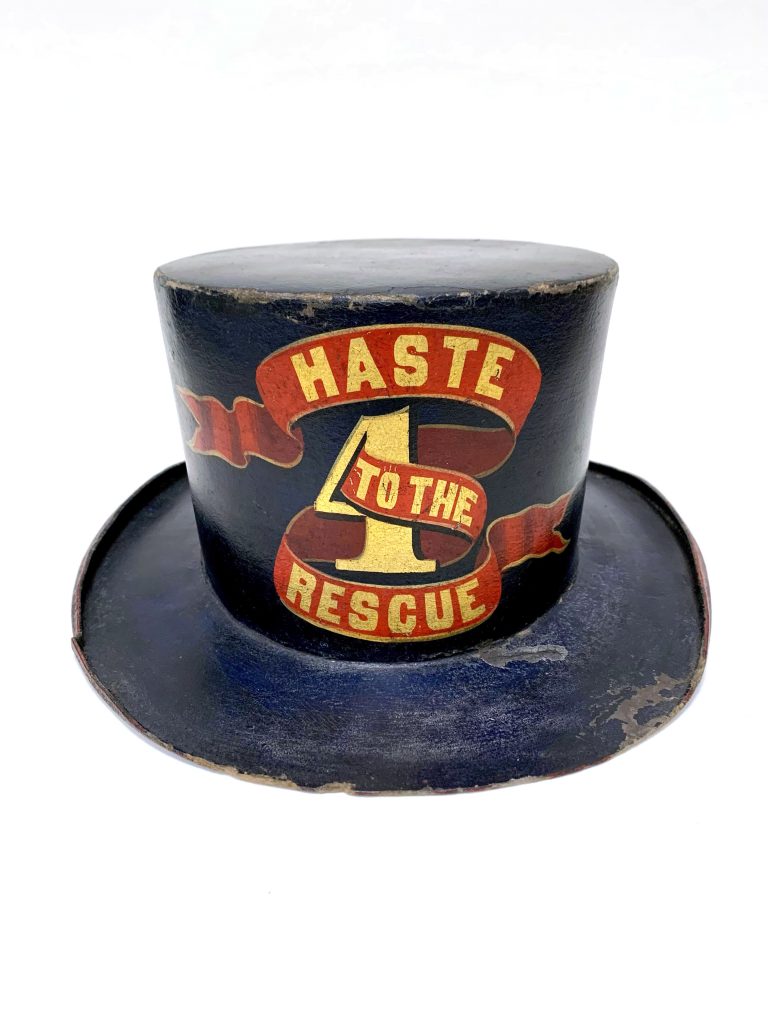
The artwork on the front of this hat references Cincinnati Fire Engine Company Number Four, which was formed in May 1820. They were originally located on Sycamore Street near lower Market, before moving to Sycamore and Third Streets, and later to Hammond and Third. In 1826 they became known as Eagle Fire Company, Number Four. And then in 1830, their name changed once again to the Franklin Fire Engine and Hose Company, Number Four. Much of my research on the Cincinnati firefighting collection came from the Cincinnati Fire Department Records (Mss 500), which are in the museum’s archives.
Sticking with dark blue, this Union Army frock coat was worn by Colonel Gustav Rudolf Tafel (1830/32-1908) during the American Civil War. Tafel was born in Munich in 1830 or 1832, came to America and eventually settled in the Over-the-Rhine neighborhood of Cincinnati around 1848. He worked as an apprentice printer, newspaper reporter, and later studied law. He was very active in the German community in Cincinnati, and at the outbreak of the Civil War in 1861 helped raise several companies of troops to form the 9th Ohio Volunteer Infantry Regiment, also known as “Die Neuner.” Tafel saw action with the 9th OVI in West Virginia and Kentucky, and was twice wounded in action. After the war, he returned to the practice of law, became a judge, and remained active in civic affairs. He served one term in the Ohio State House of Representatives (1866-1868) and was elected mayor of Cincinnati in 1897, serving until 1900.
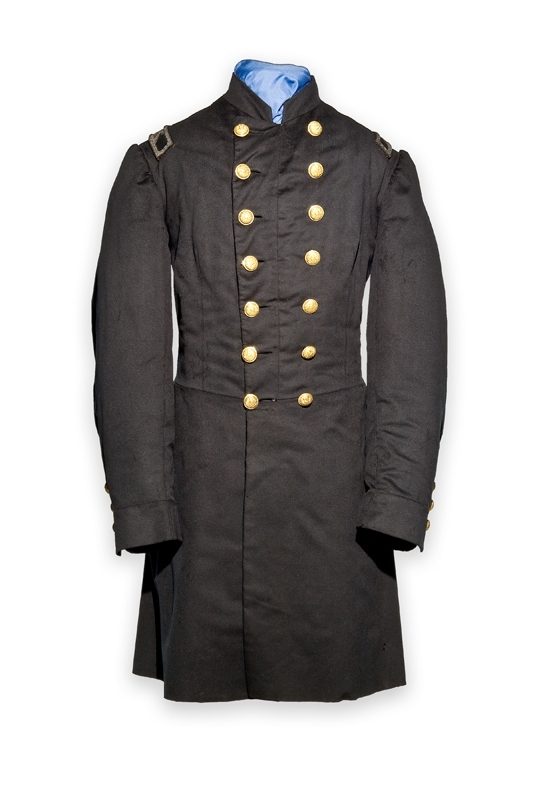
Why blue uniforms, you may ask. The tradition of wearing blue dates to Colonial America. Blue was a favorite color of colonial militias as a contrast to the customary red used by British regulars. Also, the indigo used for blue dye was grown in the colonies, whereas most red dyes were imported from Europe. The first standardized uniform used by the Continental Army was also blue. Jumping forward a few decades, the U.S. Army Uniform Regulations of 1821 includes the statement, “Dark blue is the National Color.” Light blue trousers were added in the 1820s, made of a coarser cloth called kersey, which was cheaper than the expensive wool broadcloth used for coats. It wasn’t until 1902 that regulations moved away from blue and adopted the now-familiar olive drab.
Fun fact: in 2023 Colonel Tafel returned to Germany, in a way. His frock coat was loaned to a museum in Baden-Wurttemburg for an exhibition called "The American Dream: Badeners and Wurttembergers in America,” highlighting the significant accomplishments of German immigrants in America.
For a more feminine turn, we have this two-piece day dress from circa 1872-1878. It’s made of blue-ribbed silk with brocade on the bodice and skirt, and decorated with silver and chenille fringe. It features a taffeta peplum detail that falls into the back bustle and train.
The donor said this dress was the afternoon dress of Mrs. Margaret (Yost) Schmidlapp (1851-1923). She was born in Cincinnati, the daughter of Conrad and Margaret (Bachman) Yost. In March 1871 she married businessman Charles Schmidlapp (1841-1885), of Piqua, Ohio. Charles’s brother is well-known financier and philanthropist, Jacob Godfrey Schmidlapp. The dress was donated in 1958 by Margaret’s granddaughter, Margaret Elizabeth Conklin. And while I’d love to tell you more details about Margaret and her life, unfortunately, that information was not written down, so more research will need to be done.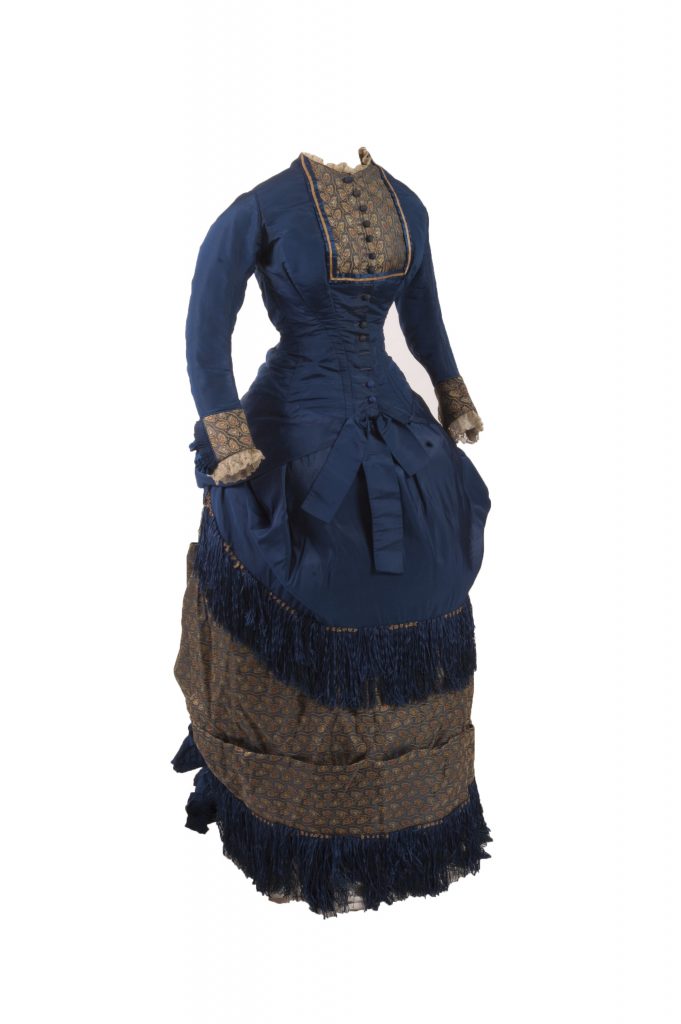
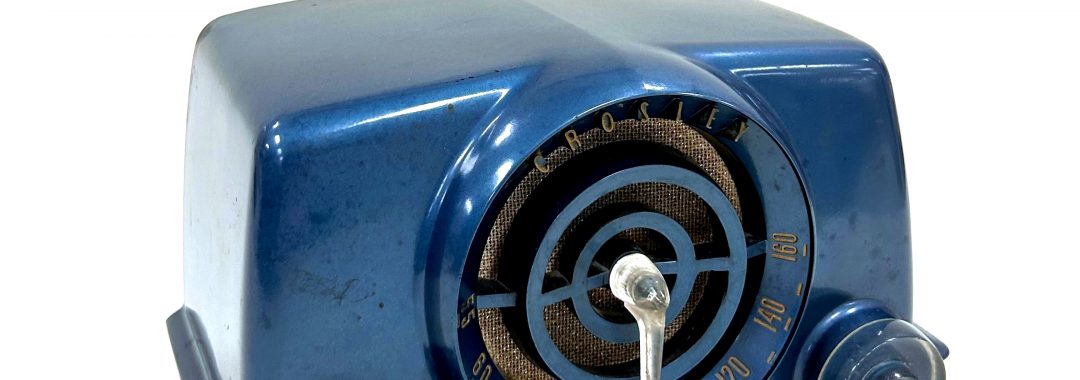
Another favorite of mine, this 1951 Crosley “Bullseye” radio, model D-0BE, is part of the Dynamic 11-100 series, manufactured by the Crosley Division of AVCO. The “Bullseye” was part of Crosley’s 1951 color-styled radios, the “Coloradios.” With a molded Bakelite case (Bakelite was the first synthetic plastic, introduced in 1907), each model number in the series relates to a specific color. The design is credited to Carl Reynolds, Jr., who was issued design patent number 160,538 in 1950. The reason I really like this object is that it’s a great example of post-World War II consumer products embracing a streamlined, aerodynamic style, reminiscent of jet airplanes. Sleek, bullet-nose jet-inspired automobile design in turn inspired electronics like the Crosley “Bullseye” radio with its speedometer-looking dial and speaker grille.
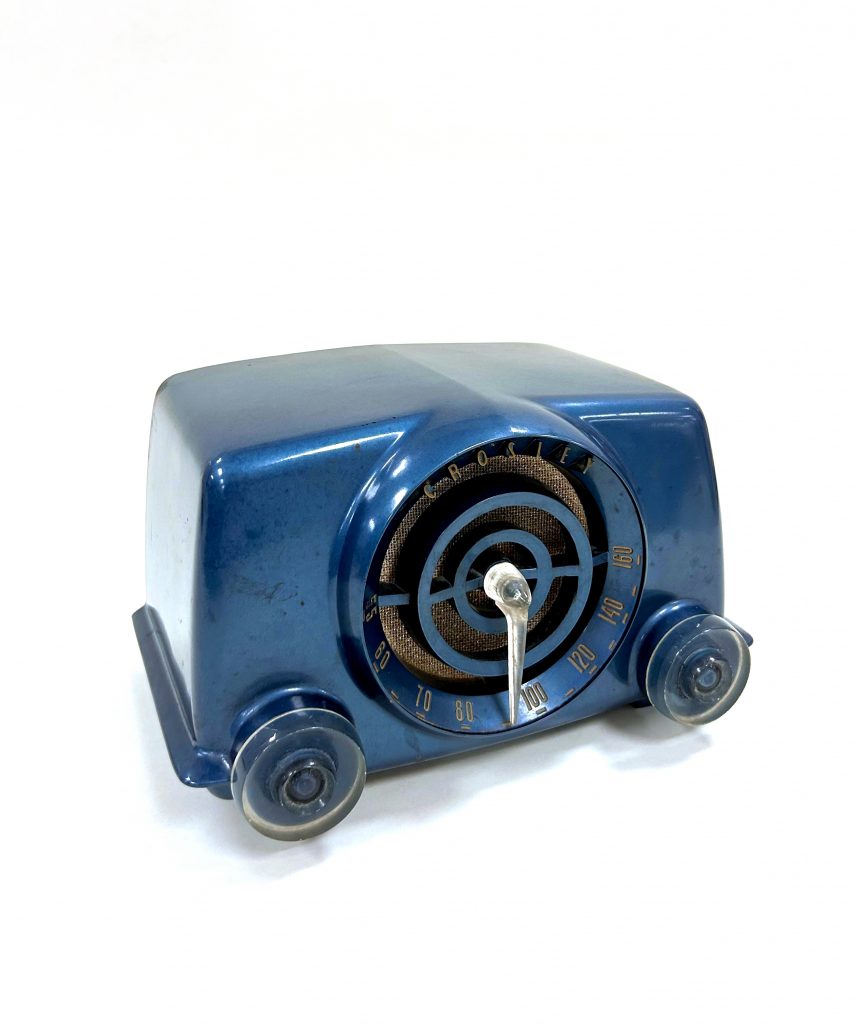
Of course, Crosley Radio Corporation’s pioneering contributions to radio manufacture begins long before 1951. In 1921, they introduced the “Harko” crystal radio set, the first low-priced radio on the market, selling for $7, and in 1925 they introduced the Crosley “Pup,” a small one-tube regenerative radio, which sold for $8.75. By making affordable radios that were accessible to middle-class America, Crosley became the largest radio manufacturer in the world by 1925.
And let’s end our jaunt through the blue fields of history with the classic Easy Bake Oven. One of the most iconic toys of postwar America, it was introduced in 1963 by Cincinnati toy company, Kenner Products. Kenner was formed in 1947 by the Steiner brothers Joseph, Albert and Phillip. The company took its name from its original location on Kenner Street, which runs along the north side of Cincinnati Union Terminal. Kenner originally produced a variety of everyday consumer products before expanding their line to toys with the Bubbl-Matic, a toy pistol that blew bubbles.
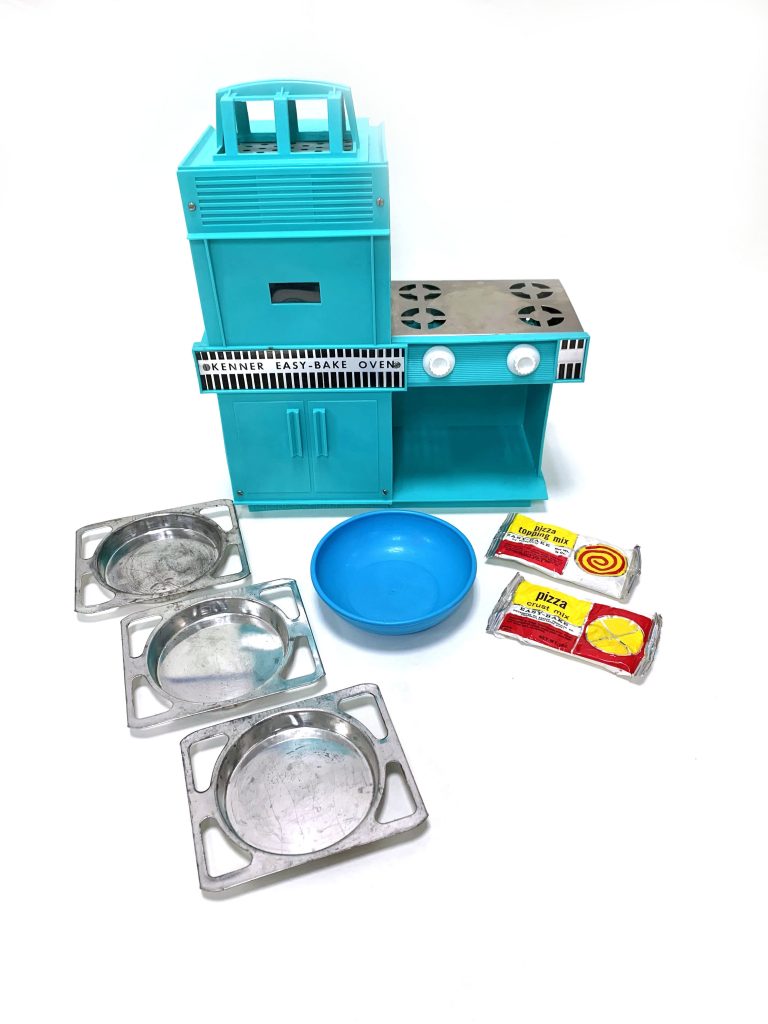
But it was the Easy Bake Oven put them on the map. The original ovens were offered in yellow and turquois and used two 100-watt incandescent light bulbs as the heat source. Half a million ovens were sold in the first year of production, and the five-millionth was sold in 1972. This iconic toy was inducted into the National Toy Hall of Fame in 2006.
Image IDs – in order of the blog
Cincinnati Centennial pitcher, 1888 (CHS.FA.196
Rookwood peacock bookends, 1920 (CHS.1978.40.01a-b)
Rookwood sphinx candlestick holders, 1920 (CHS.1995.24.01a-b)
BOSS Stoves ashtray, 1947 (CHS.1986.184)
Hemingray bird relish dish, c.1876 (2001.108.6)
Hemingray telegraph insulator, n.d. (2004.217.14)
Fireman’s parade hat, n.d. (CHS.1958.5.11)
Union Army frock coat, 1861-1865 (2005.190.01)
Two-piece day dress, c.1872-1878 (CHS.1958.3.1)
Crosley “Bullseye” radio, 1951 (CHS.1989.142.3)
Easy Bake Oven, 1964 (2017.32.01-07)