
A Rare Advertising Card and Its Connection to the Titanic
By: Anne Kling
A recently-donated advertising card highlights a successful Cincinnati business from the late 19th century. The rare item also has an unexpected connection to the story of the Titanic!
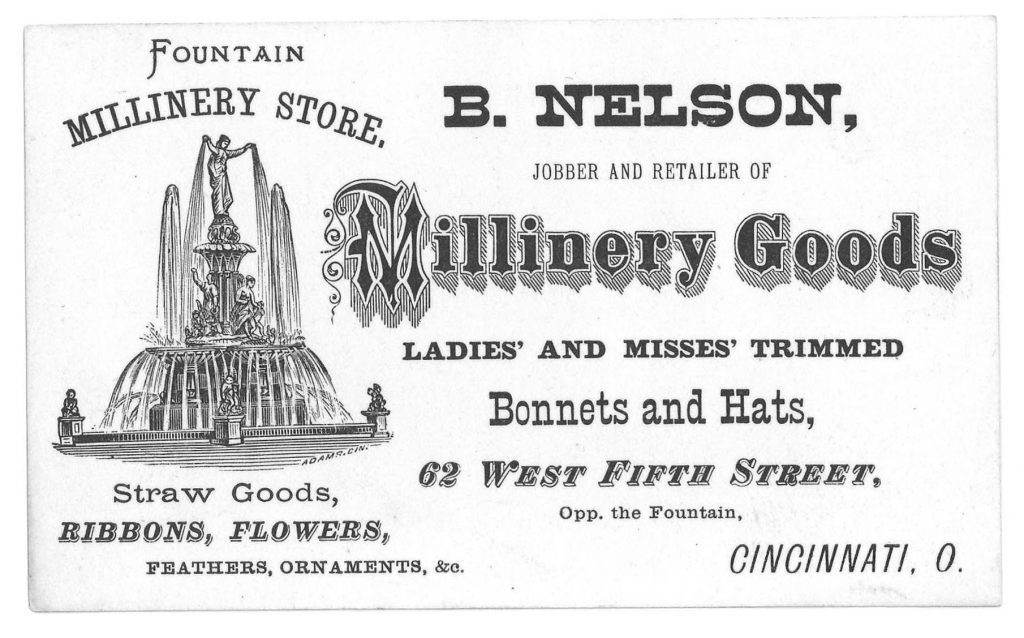
Advertising cards became popular in the late 19th century as a way for businesses to promote their products. The cards came in various sizes. Some were similar to a modern business card, like this one which has black-and-white text in decorative fonts and a simple illustration.
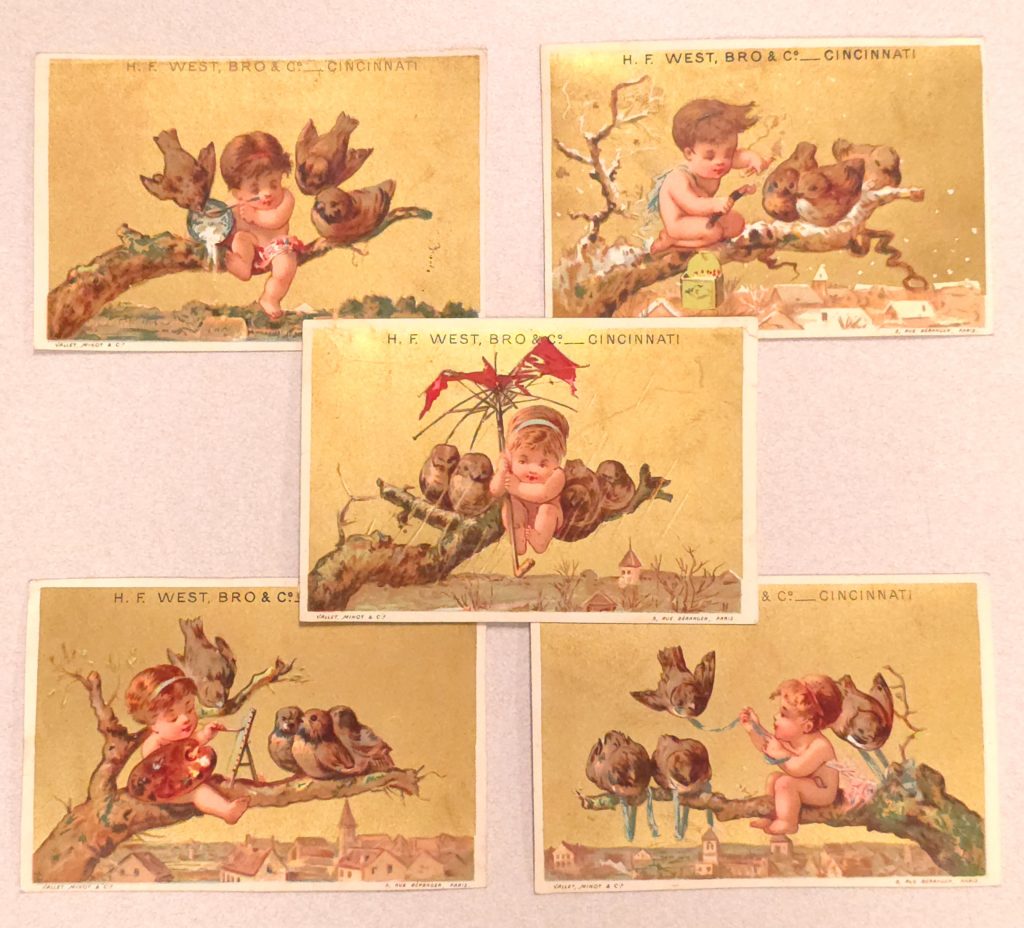
Other cards had colorful illustrations, often with romanticized or comical images of children and animals. Sometimes the illustrations related to the product that was being sold. A card for a shoe store might have an image that included shoes or boots, for example, while other illustrations might have no obvious connection to the product or business.
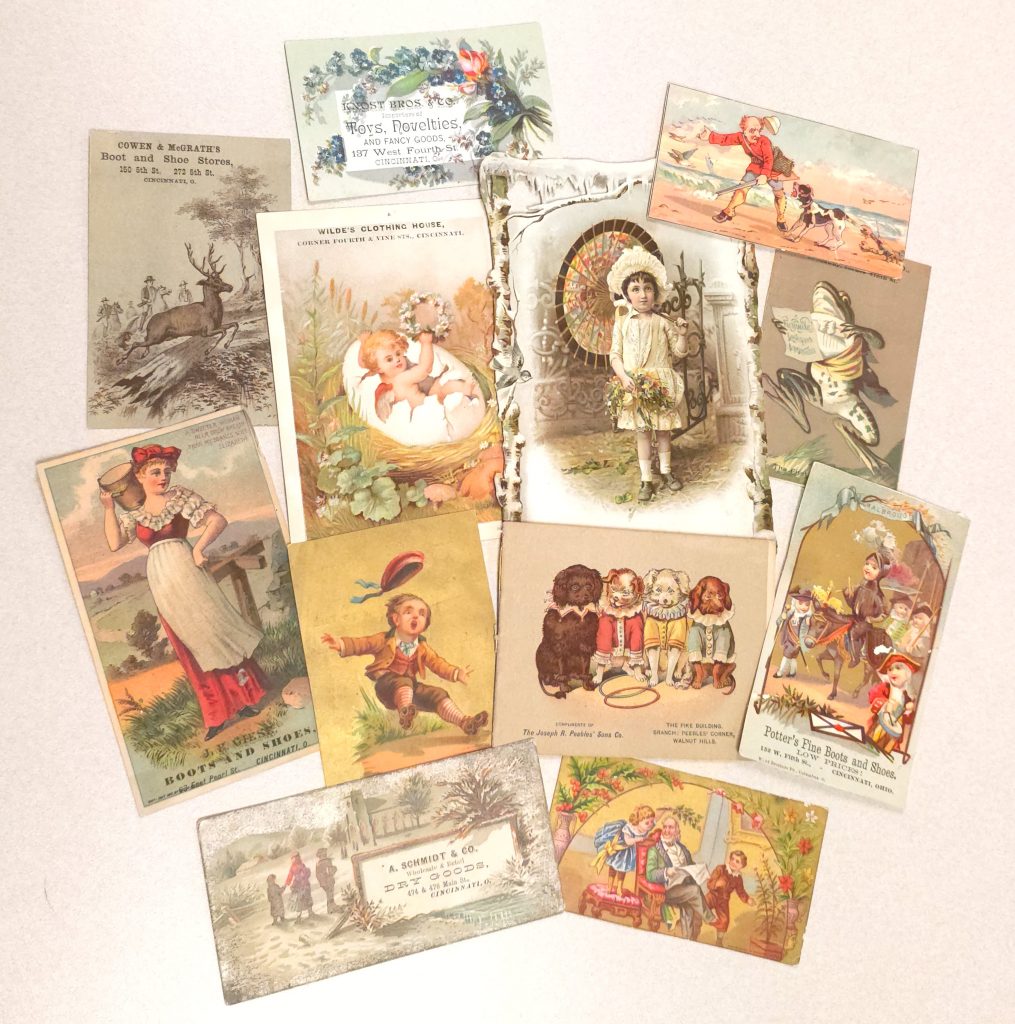
While baseball cards were avidly sought after by collectors in the 20th century, advertising cards were the popular items in the Victorian era. Collectors frequently arranged the cards in scrapbooks, pasting them into place. Some businesses would release a series of cards on a certain theme to entice their fans to “collect them all.”
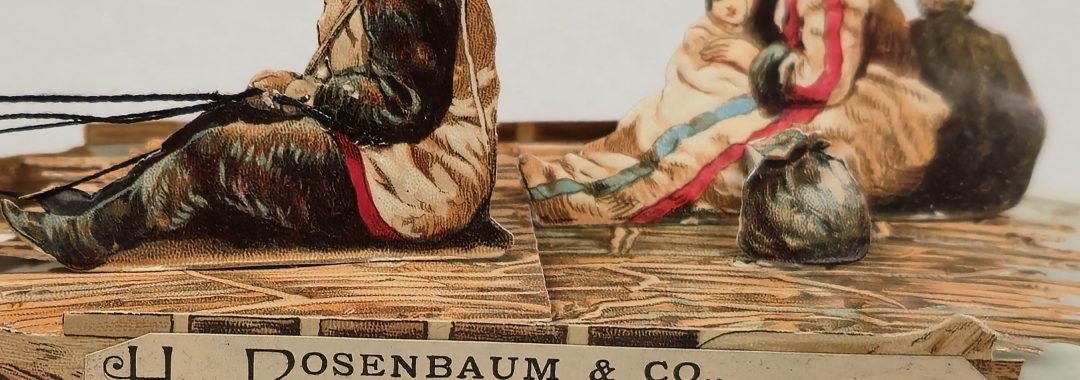
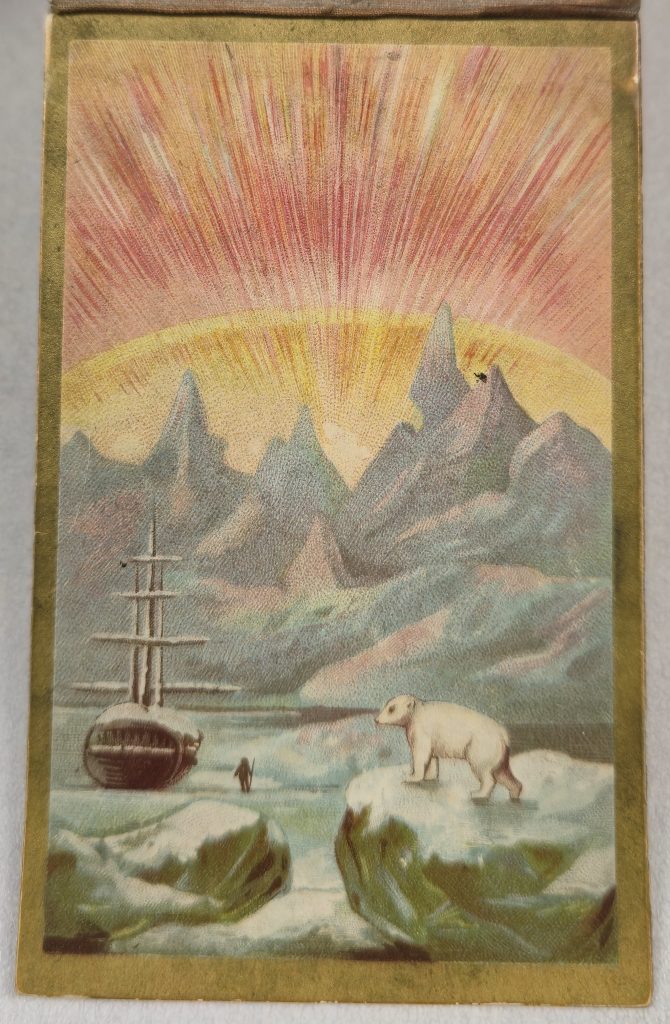
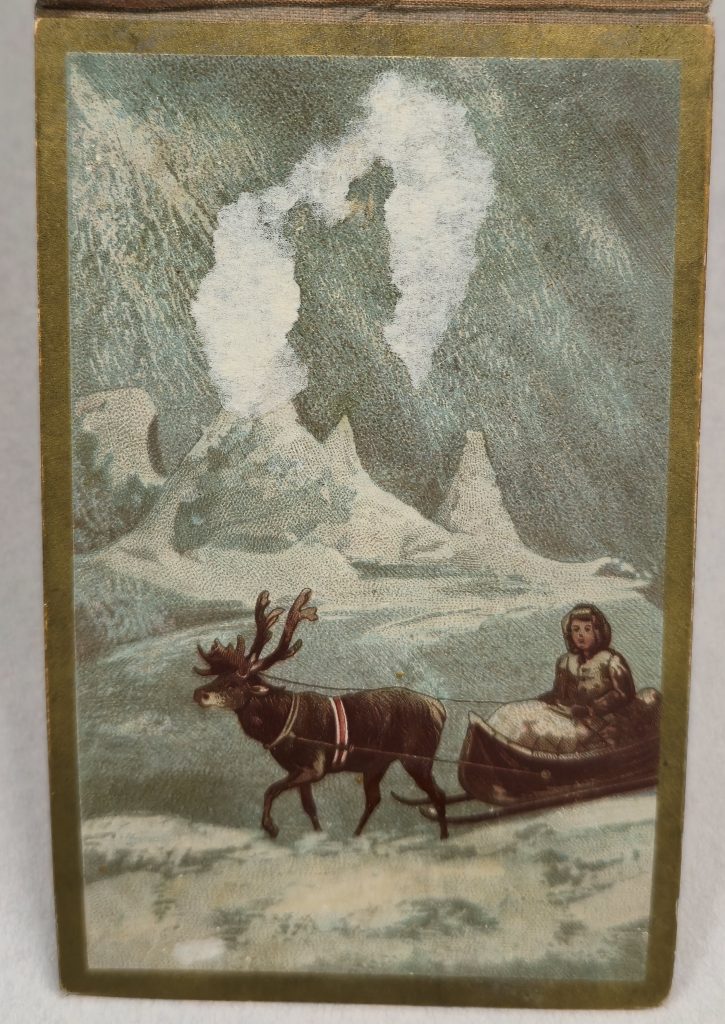
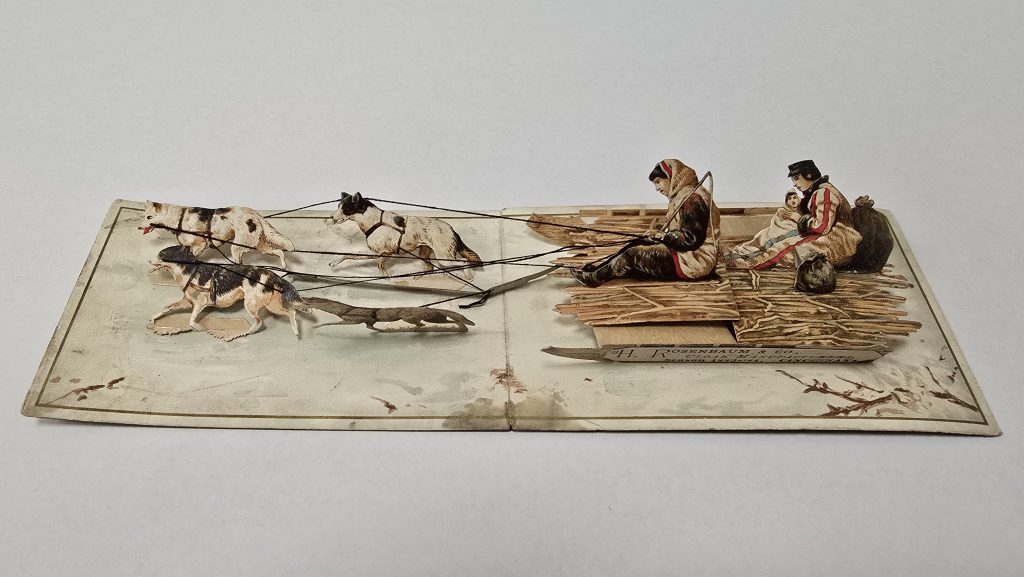
The new advertising card Cincinnati Museum Center received last year is an advertisement for H. Rosenbaum & Co. What makes this card special is that it’s a folded card that turns into a pop-up display when opened. The card is approximately 2 15/16 x 4 11/16 inches when folded and 2 15/16 x 9 7/16 inches when opened. The outside of the card depicts two arctic scenes. One side has a colorful sunrise over white mountains with a sailing ship and a polar bear in the foreground. The other side shows a reindeer pulling a person in a canoe-shaped sled past mountains during a snowstorm. (This side of the card shows the remnants of glue and paper, probably from a scrapbook!)
When the card is opened, it reveals a 3-dimensional, pop-up display of a family on a wooden sled being pulled by a team of four sled dogs. One side of the sled says, “H. Rosenbaum & Co. Cloak Manufacturers, Season 1883-84, Cincinnati.” The other side announces “Fur-trimmed and Fur-lined Goods a Specialty.”
H. Rosenbaum & Co. was established by Henry Rosenbaum in 1878. Henry was born into a Jewish family in New York City in 1851, and his family moved to Cincinnati when he was a small child. Henry attended Cincinnati Public Schools and Hughes High School. When he was 14, he went to work as a clerk at a local business. After working for a number of firms, he decided to start his own business. Years later, a book highlighting some of the “leading citizens” of Cincinnati described Henry’s business success in this way:
“In 1878, he opened a cloak manufactory on Vine Street, near Fourth, where his business grew so rapidly as to warrant him a year later in moving into more commodious quarters at Race Street, between Third and Fourth. He started in 1878 with thirty employees. Eight years later he had on his payroll the names of twelve hundred skilled artisans in all the branches of cloak-making. Again, in 1886, the quarters on Race, below Fourth, became cramped on account of increasing business, and the subject of this sketch again expanded by moving to 250, 252, 254, and 256 Race Street, opposite the John Shillito establishment. Here his business occupied seven floors of an immense building, all devoted to the making of cloaks for women and children, constituting the largest cloak-making establishment west of the Alleghanies, if not the largest in the United States. Here expanding business made it necessary, in the fall of 1895, for him to again move. He now occupies the entire building on the southwest corner of Race and Fourth Streets. Every foot of space in it, from the subcellar to the roof, is devoted either to the manufacturing of cloaks or their sale. The retail feature of his establishment, a feature introduced when the new building was first occupied, is one of the distinguishing points of interest in the Queen City. Nearly a million dollars’ worth of garments of this kind are annually turned out from this establishment. The Rosenbaum cloaks are known from New York to Chicago.”
Roe, George Mortimer, ed. Cincinnati: The Queen City of the West. Her Principal Men and Institutions. Biographical Sketches and Portraits of Leading Citizens. Descriptive Accounts of Her Enterprises ... Cincinnati: Press of C.J. Krehbiel & Co., 1895, pp. 205-206. (Cincinnati Museum Center, General f917.714 R698)
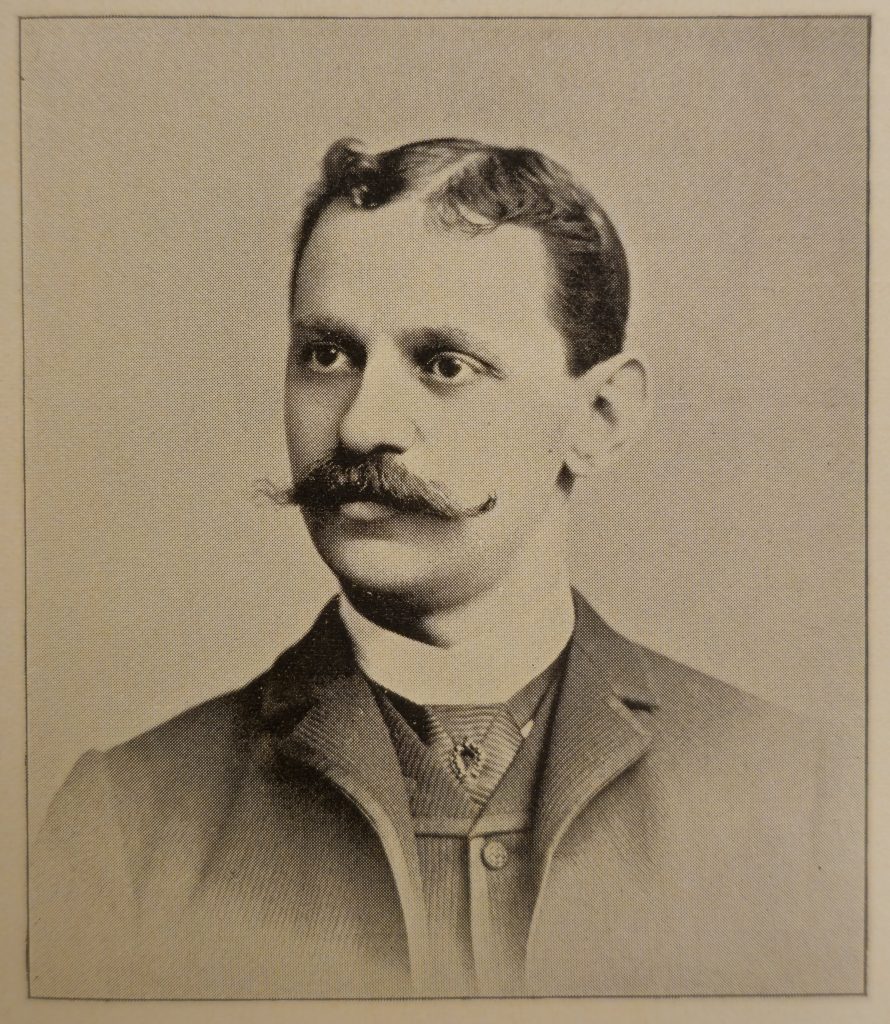
Also in 1878, Henry Rosenbaum married Sophia Hollstein, the daughter of a local merchant. Henry and Sophia had one child, a daughter named Edith who was born in 1879. The Rosenbaum family lived at various locations in Cincinnati from 1878 to 1902, including on McMillan Street, Francis Lane, and at the corner of Lincoln and Melrose Avenues. Henry and his family moved to New York City in 1902.
Edith Rosenbaum went on to have a notable career in the fashion industry. (Her choice of career may have been influenced by her father’s successful business.) She moved to Paris in 1908 and secured her first job in the French fashion world as a saleswoman for the fashion house, Maison Cheruit. Then in 1911 she became the first Parisian correspondent for Women’s Wear Daily, a New York fashion-industry trade journal.
Edith, however, is best known for being a survivor of the Titanic. On April 10, 1912, she boarded the RMS Titanic in Cherbourg, France, on its maiden voyage to New York City. It is believed that, in addition to her own first-class cabin, Edith also reserved a second cabin to store her 19 trunks which were filled with some of the newest French fashions. Edith escaped from the sinking ship on Lifeboat 11 with just the clothes she was wearing and a musical toy pig that her mother had given to her for good luck following a tragic automobile accident the year before which killed Edith’s fiancé. The pig was made of papier-mâché and covered in black and white fur. It played the tune "The Maxixe" when its tail was wound. Edith used the musical pig to entertain the frightened children in the lifeboat for hours until they were rescued.
Over the decades following the tragedy, Edith was very willing to share her experience on the Titanic with others. She gave numerous interviews and was frequently depicted in books and movies about the Titanic. She was Cincinnati’s most famous Titanic passenger. Edith passed away in London in 1975 at the age of 95. Her toy pig was donated to the United Kingdom’s National Maritime Museum in Greenwich, London, where it will be preserved for future generations.