
The Role of Women in 20th Century Academic Departments: Meet Elizabeth Dalvé from the University of Cincinnati
By: Brenda Hunda, PhD, Curator of Invertebrate Paleontology and Cameron E. Schwalbach, Paleontology Collections Manager
Geology is the scientific study of our Earth and its 4.6-billion-year history, encompassing a wide variety of scientific concepts and techniques to investigate everything from Earth’s physical structure to the evolution of life on its surface. However, despite being a field of such diversity, geology and its disciplines have been traditionally dominated by men. Women made early contributions to the field inside-and-out of academia, but were denied professional positions for decades. Years of gradual but continuous gains for women in the geosciences have resulted in higher numbers of women with geoscience PhDs today, but this has failed to translate to faculty positions, with roughly one-in-four professors likely to be a woman. While there has been progress made to the position and representation of women in geology, the foundation for this transformation in the geological sciences over the last 200 years began, in part, with women in scientific illustration.
In the 17th through early 19th centuries, women were largely excluded from universities and scientific societies. Women often worked in science informally – through family connections or private study. Scientific illustration, however, was one of the few acceptable activities because it was considered appropriate for women, although it was not formally recognized as a skill within a university but rather adjacent to them. By the early 19th century, science became a profession within universities, but women were still excluded in formal roles such as professors or researchers. Women mainly contributed to science by being assistants, drawing specimens and preparing plates for publication for male faculty. Their work was seldom credited even though it was essential.
By the late 19th to early 20th century women began appearing in supportive roles such as illustrators, lab assistants, and data processors. Scientific illustration became an acceptable and recognized role in academic departments. Even though drawing was seen as a “feminine” skill, the work required anatomical knowledge, intense observation and precision, and synthesis of volumes of scientific information. By the mid-20th century, women made a pivotal transition from simply illustrating others’ work to illustrating and researching their own projects, although gaining recognition for their work was still not commonplace.
This is where we meet Elizabeth A. Dalvé (1907-1981) (Figure 1). Known by her friends as Bettina, she was a scientific illustrator and artist that resided in Cincinnati, Ohio. Her interest in fossils started when she first moved to Cincinnati and saw fossils in the creek beds. She first volunteered at the University of Cincinnati Geology Museum in 1938, and by 1945 she was Acting Curator. Her main self-described “hobby” was to revamp the museum, transforming the formerly drab collection into a new exciting presentation of the “parade of life” (Figure 2). She was elected Vice President of the Dry Dredgers in 1943, a local amateur fossil group in Cincinnati. She made the transition from illustrator to illustrator-researcher with a Master’s degree from the University of Cincinnati in 1948, titled “The Fossil Fauna of the Ordovician in the Cincinnati Region”. Among her many accolades, she became a member of the Geology Section of the Ohio Academy of Science in 1949 and was elected to Fellow of the Ohio Academy of Science in 1963.

Figure 1. Elizabeth Dalvé showing some of her illustrations for the University of Cincinnati Geology Museum.
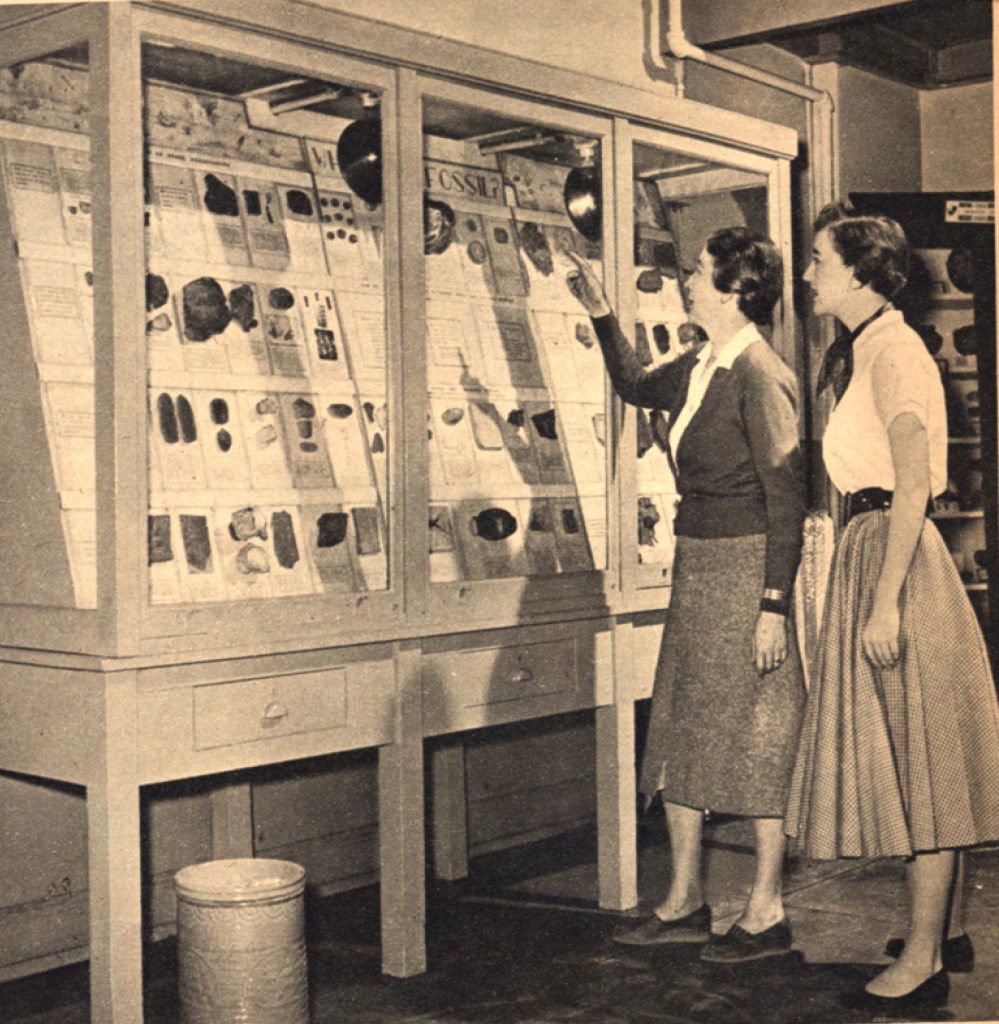
Figure 2. Elizabeth Dalvé (left) showing a geology students a display of fossils in the University of Cincinnati Geology Museum.
Elizabeth played an important role in the long history of invertebrate paleontology in the Cincinnati region. Ever since some of the earliest studies of Cincinnatian fossils and strata by members of the “Cincinnati School of Paleontology,” paleontologists have recognized that fossil assemblages change through the section and show a close relationship to the character of the rock. For example, fossils of organisms of some taxa occur in many formations and thus have long stratigraphic ranges; fossils of other taxa are restricted to single formations or thinner intervals within a formation, even single beds. Using this kind of information on fossil distribution, one could predict what fossils might be found in a given rock-unit.
Bettina knew this, and during her time as a part-time museum assistant in the Geology Department at the University of Cincinnati, she compiled a complete list of the stratigraphic occurrences of the fossils reported in the type-Cincinnatian (Dalvé, 1948). This detailed and comprehensive work of her Masters thesis is strongly reminiscent of some of the compilations of members of the “Cincinnati School of Paleontology”, notably Joseph F. James who published the Catalogue of the Fossils for the Cincinnati Group in 1878.
Kenneth E. Caster used Dalvé’s faunal list in revising a guidebook to the fossils of the area originally published informally by Walter H. Bucher and others in 1939. This guidebook, the Elementary Guide to the fossils and strata of the Ordovician in the vicinity of Cincinnati, Ohio (Caster et al., 1955) became a classic reference for amateurs and professionals and remains an indispensable component of any Cincinnatian paleontologist’s library. The well-known faunal changes of Cincinnatian taxa expressed as biostratigraphic zonation in the guide would not have been possible without Dalvé’s work.
Dalvé’s artistic vision and skills of illustrating Cincinnatian paleontology even found their way into a textbook. A drawing depicting a reconstruction of life on the Cincinnatian seafloor, done in collaboration with Anneliese Caster (Dr. Kenneth Caster’s wife), was featured in Geology by von Engelin and Caster (1952, fig. 347) and in Meyer and Davis’s A Sea Without Fish (2009, p. 238, fig. 16.2) (Figure 3). In fact, many of the illustrations of this seminal work by von Engelin and Caster was done by Elizabeth, often in collaboration with Anneliese Caster and her equally talented mother, Elizabeth King.

Figure 3. Elizabeth Dalvé's illustration of an Ordovician sea ecosystem from the 1952 book Geology by von Engeln and Caster. This image is also illustrated in Meyer and Davis's 2009 book A Sea Without Fish. Portions of this image have been modified and used in the exhibit Ancient Worlds Hiding in Plain Sight at Cincinnati Museum Center.
Elizabeth Dalvé was especially skilled in the scientific illustration of plants (Braun, 1961). Her most important contribution to the Ohio Academy of Science was the production of several hundred detailed pen and ink drawings for The Woody Plants of Ohio and The Monocotytledoneae, published for the Academy by the Ohio State University Press (Figure 4). She published eight works on plants in total, and collections of her botanical illustrations are on display at The Carnegie-Mellon Institute and have been featured in exhibits at the Cincinnati Gardens Center and the Cincinnati Medical Library.
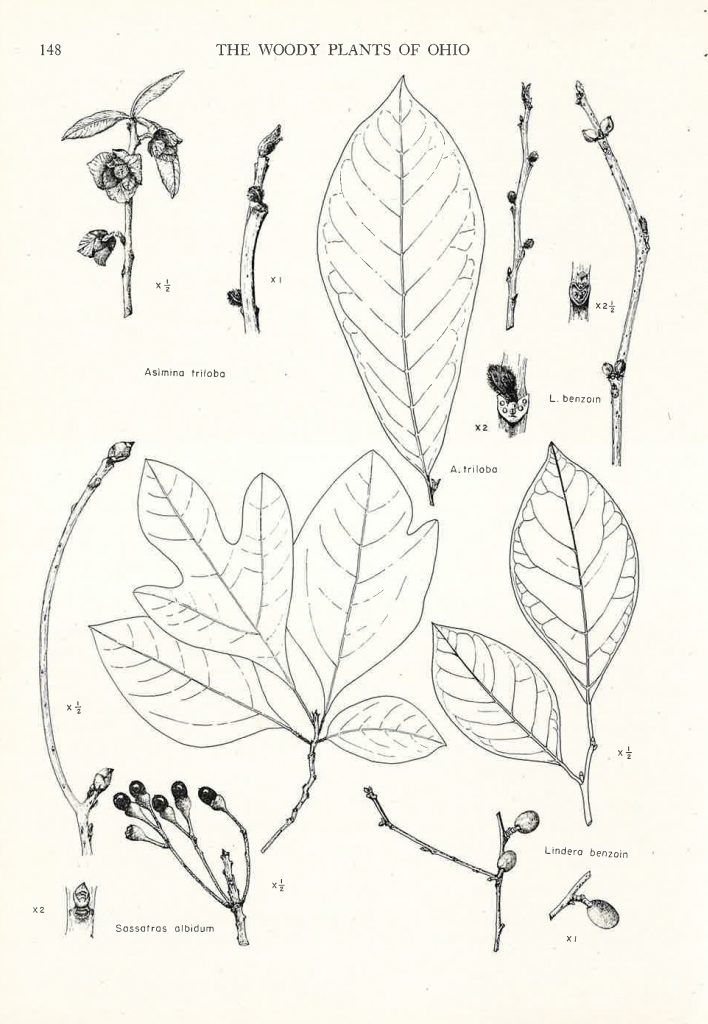
Figure 4. An illustration by Elizabeth Dalvé in Lucy Braun's 1961 book The Woody Plans of Ohio (Pawpaw and Sassafras, p. 148).
Scientific illustration was a gateway for women into academia from universities that excluded them. It helped pave the way for women’s participation in science and increased with status of scientific illustration, which we currently enjoy in books, publications, and museums worldwide. Elizabeth Dalvé’s archives are currently held at Cincinnati Museum Center and on display in the latest fossil gallery Ancient Worlds Hiding in Plain Sight which features Elizabeth’s scientific illustrations of Ordovician Period fossils of the Cincinnatian Sea. Her artistic renderings of fossils and ancient ecosystems bring whimsy to the gallery and inspires curiosity and creativity in our visitors. Elizabeth knew, long ago, what we are learning now: that art and science work together to transport us back to 450-million-year-old ancient worlds, right here in Cincinnati.
References:
Braun, E. L. 1961. The Woody Plants of Ohio. Ohio State University Press, 376 p.
Braun, E. L. 1961. The Monocotyledoneae. Ohio University Press, 464 p.
Caster, K. E., and O. D. Von Engeln. 1952. Geology. McGraw-Hill, Inc., 730 p.
Caster, K. E., Dalvé, E. L. and Pope, J. K. 1955. Elementary Guide to the fossils and strata of the Ordovician in the vicinity of Cincinnati, Ohio. 61 p.
Dalvé, E. 1948. The fossil fauna of the Ordovician in the Cincinnati region. Department of Geology and Geography, University of Cincinnati, Cincinnati, Ohio.
Meyer, D. L., and R. A. Davis. 2009. A Sea Without Fish. Life in the Ordovician Sea of the Cincinnati Region. Indiana University Press, 346 p.