
Thomas Jefferson and the Mastodon
By: Glenn W. Storrs, Ph.D., Withrow Farny Curator of Vertebrate Paleontology
When we study history – including the history of science – we use many sources to make sense of what actually happened. One of our country’s Founding Fathers practiced these methods with items that are now part of Cincinnati Museum Center’s collections, and helped change the course of science as a result.
During the late 1700s and early 1800s, Thomas Jefferson was an influential figure. He not only helped create the United States of America, but he also helped bring the ideas of the “Age of Enlightenment” to the New World. He believed that enlightened citizens should explore theories by using reason, gathering evidence and testing ideas using the scientific method. Jefferson used these methods himself in his many roles as statesman, governor, ambassador and president. As the governor of Virginia during the American Revolution (1779-1781), Jefferson was an amateur naturalist and Renaissance man who sought to understand the natural history of Virginia. Later, as president (1801-1809), he wanted to explore the natural history of the Louisiana Purchase (1803), which expanded the new country to the west. Part of Jefferson’s quest for knowledge arose from his desire to disprove a European belief in “American degeneracy.”
Though others invented the idea of American degeneracy, the French naturalist Georges-Louis LeClerc, Comte de Buffon, wrote prominently about it in a series of 44 volumes (Histoire naturelle, générale et particulière) published between 1749 and 1809. Buffon suggested that because of the New World’s “inferior” climate and environmental conditions, large, diverse animals and great civilizations could not exist there. Jefferson and others set out to prove Buffon wrong. They needed evidence of the history of a spectacular animal, and Jefferson focused on the American “Incognitum” or “mammoth,” now known as the American Mastodon (Mammut americanum). Since 1739, people had often found remains of this species along the Ohio River at Big Bone Lick, Kentucky (which was a part of Virginia until 1792). American naturalists used these fossil bones and teeth as evidence that the continent could support large animals, and the mastodon became an important political symbol for the new nation.
To prove Buffon and his colleagues wrong, Jefferson needed evidence. He wanted to acquire bones and teeth of the “mammoth,” and exploring the Louisiana Purchase provided an opportunity. President Jefferson had created the Corps of Discovery to explore the Louisiana Purchase and find a navigable route to the Pacific Ocean. He instructed Meriwether Lewis to send back “mammoth” specimens from the Kentucky lick in 1803 while he traveled to join William Clark and the Corps on their expedition up the Missouri River. Unfortunately, after a boating mishap, Lewis’ fossils ended up at the bottom of the Mississippi River on their way to Jefferson.
Yet all was not lost. Jefferson funded Clark to conduct the first formal excavation for fossils at Big Bone Lick in September of 1807, in what is now recognized as the beginning of the science of vertebrate paleontology in America. Cincinnati Museum Center’s manuscripts collection includes a letter from Clark to James Findlay, then a recent mayor of Cincinnati, dated 21 September 1807. Writing from Big Bone Lick, Clark states, “I have collected many of the bones, teeth & tusks of the Mammoth [mastodon], and the Siberian Elephant [woolly mammoth]….” Clark sent these and other fossils from the Lick to Jefferson. Several of these fossils became the core of information about extinct Ice Age animals that had never been scientifically described.
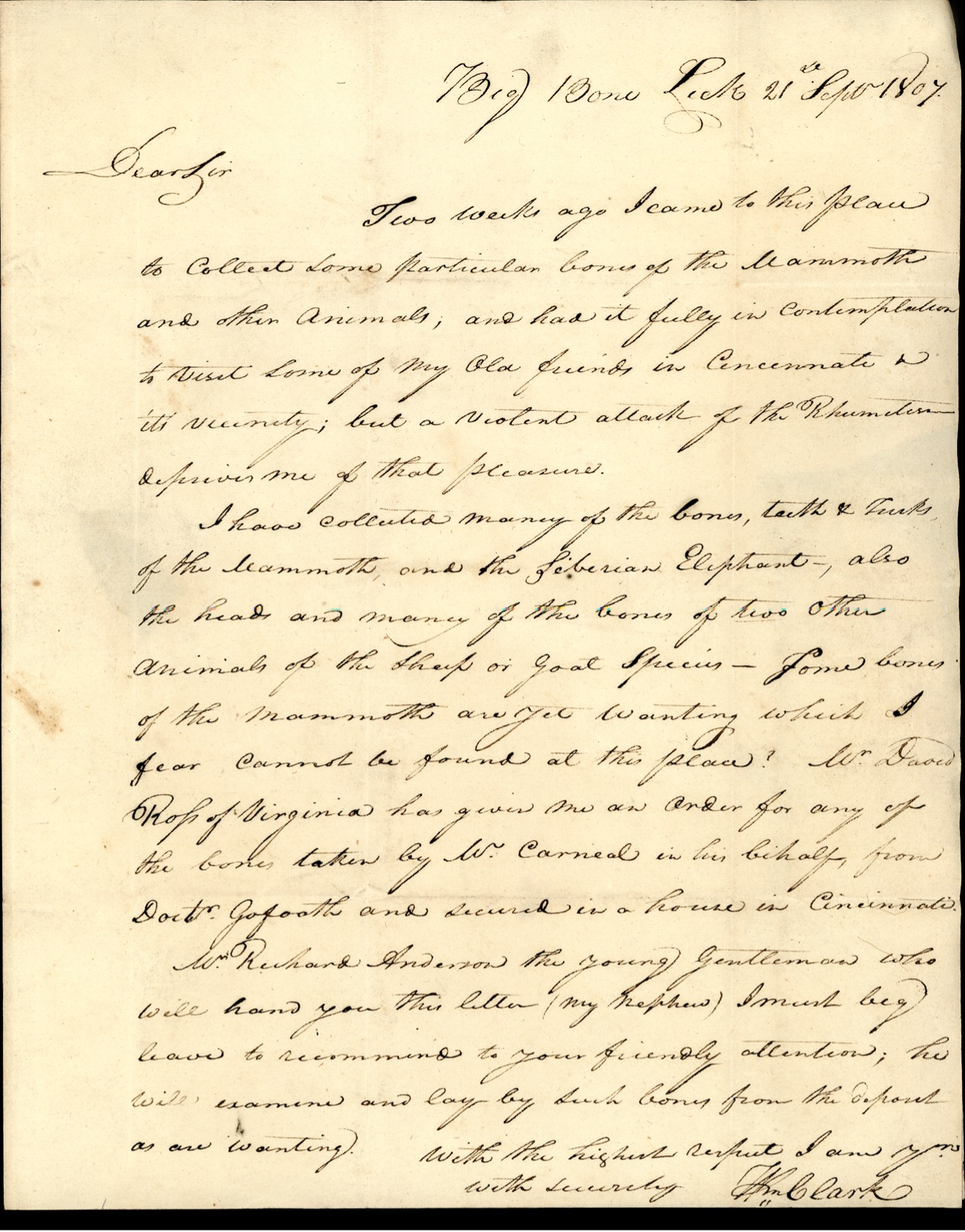
Letter from William Clark to James Findlay of Cincinnati from Big Bone Lick, dated the 21st of September 1807. Cincinnati Museum Center
Reviewing the evidence of the fossils, Jefferson and other naturalists were forced to accept that the mastodon and other Ice Age species were extinct. The concept of extinction – that organisms lived on the earth in the past and died out – was once radical because it challenged the traditional, biblically-based view of the world. But by the late 1700s, the idea of extinction had gained support in scientific circles. The French naturalist Georges Cuvier, sometimes called the “founding father of paleontology,” demonstrated conclusively that extinction was a reality in the long history of our planet. Like any good historian or scientist, he gathered data from multiple sources. Cuvier compared the bones and teeth of living elephants with the those of a Siberian Wooly Mammoth and a mastodon from Big Bone Lick. This new method – comparing anatomical details of different species – is now called comparative morphology. Cuvier’s work clearly showed that two of these species, the mammoth and mastodon, were different from each other and from living elephants and could not be found alive anywhere today.
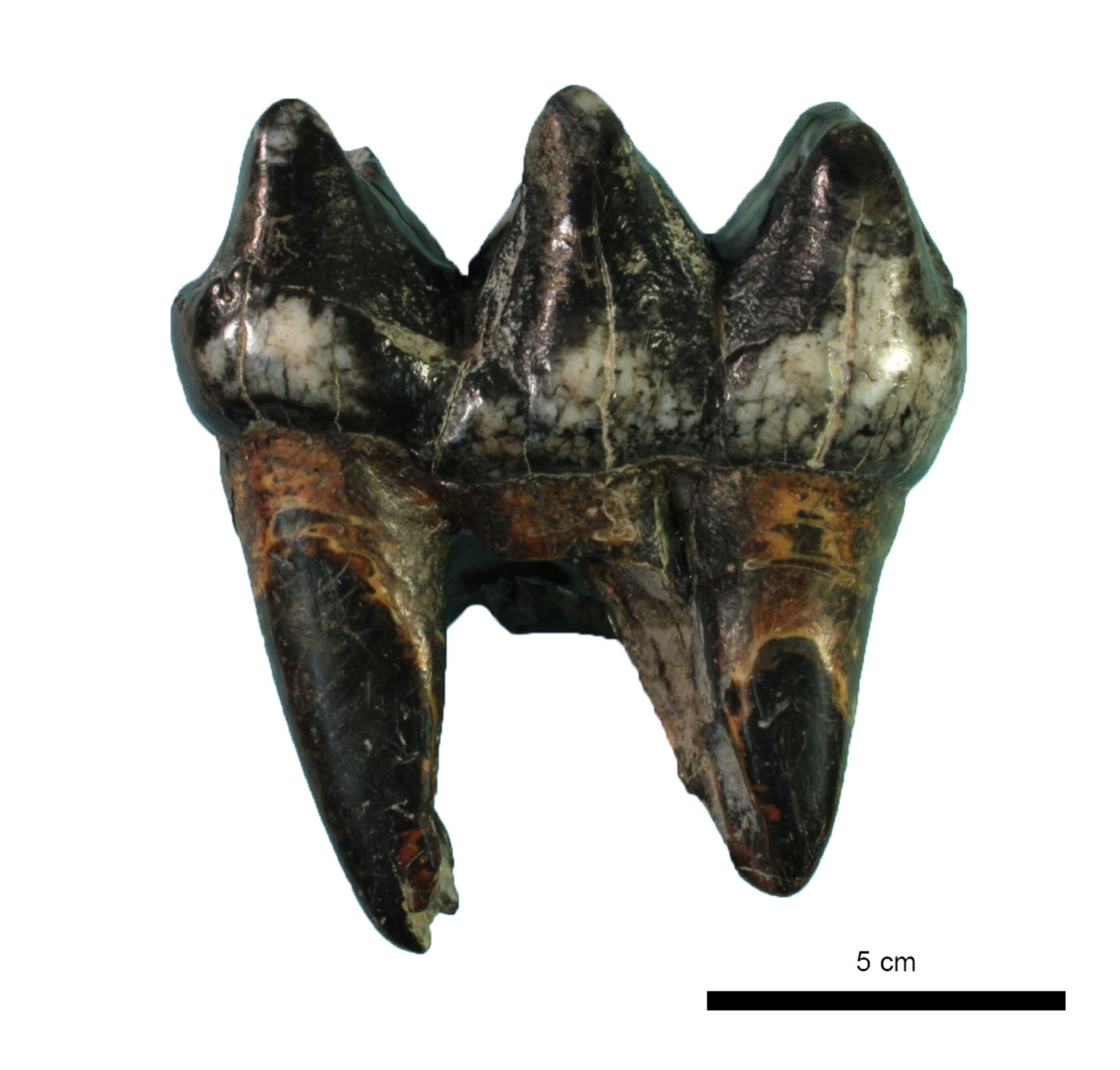
Mastodon tooth, Mammut americanum, (CMC VP11732) from Big Bone Lick, Kentucky. Presumed to have been a browsing animal, the conical cusps give the mastodon (“breast tooth”) its name. Cincinnati Museum Center
Unlike Cuvier, Jefferson had expected that the mastodon could still be alive in the wilderness of the new Louisiana Purchase, in part because of perspectives he gathered from certain Native American stories. Jefferson also drew from his non-scientific deist beliefs: he had been taught that God’s creation of nature was perfect at the beginning, but changed on its own once it was set in motion. When Lewis and Clark returned from their explorations with no living mastodons, and in light of the scientific methods and reasoning of Cuvier, Jefferson and the world realized: the American Mastodon, that early symbol of American patriotism and exceptionalism, was indeed extinct.