
FOR IMMEDIATE RELEASE: September 10, 2025
Cincinnati Museum Center fossil collection grows after summer field season
Museum and partner Elevation Science Institute recap seven-week field season
CINCINNATI - Cincinnati Museum Center (CMC) recently received a trailerful of plaster-coated care packages that add to its already expansive fossil collection – one of the largest in the country. The dinosaur fossils are the spoils of a seven-week field season in Montana led by CMC’s partner Elevation Science Institute. The fossils, numbering in the hundreds, were transported cross country on a flatbed trailer to CMC’s collection facility for care, preservation and further preparation. 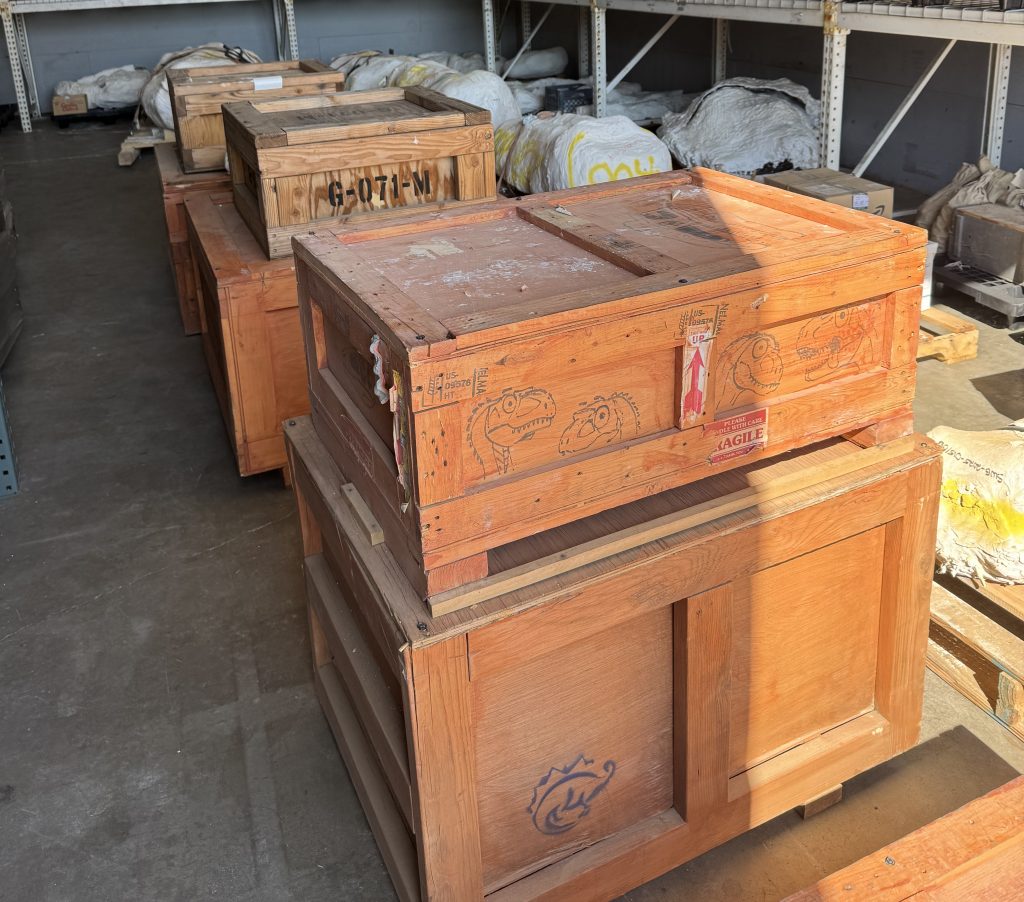
Over more than a month-and-a-half, teams of volunteers dug and dusted in the sun-scorched hills of Montana, carefully exposing and extracting a range of dinosaur fossils. More than 150 amateur paleontologists, some as young as 12 years old, worked alongside trained professionals from Elevation Science Institute during their public field school. The fossils, all collected on land managed by the Bureau of Land Management (BLM), were carefully packed and prepped for delivery to CMC, a federal repository for materials collected at BLM sites. While a majority of the fossils arrived at CMC, a portion were delivered to the Montana Natural History Center in Missoula, where they will be prepared and later transported to Cincinnati and processed into CMC’s collection.
The process
Teams of paleontologists, fossil hunters and volunteers descended on a remote area of Montana, exposed to the elements and far from paved roads. Continuing last summer’s work, they removed tarps and dirt and set to work with shovels, pickaxes, tile saws and jackhammers to carefully uncover the bones of prehistoric beasts that once ruled the Earth. Heavy hand tools and elbow grease gave way to brushes as rocks, dirt and dust fell away to reveal limbs, skulls and ribs.
The haul
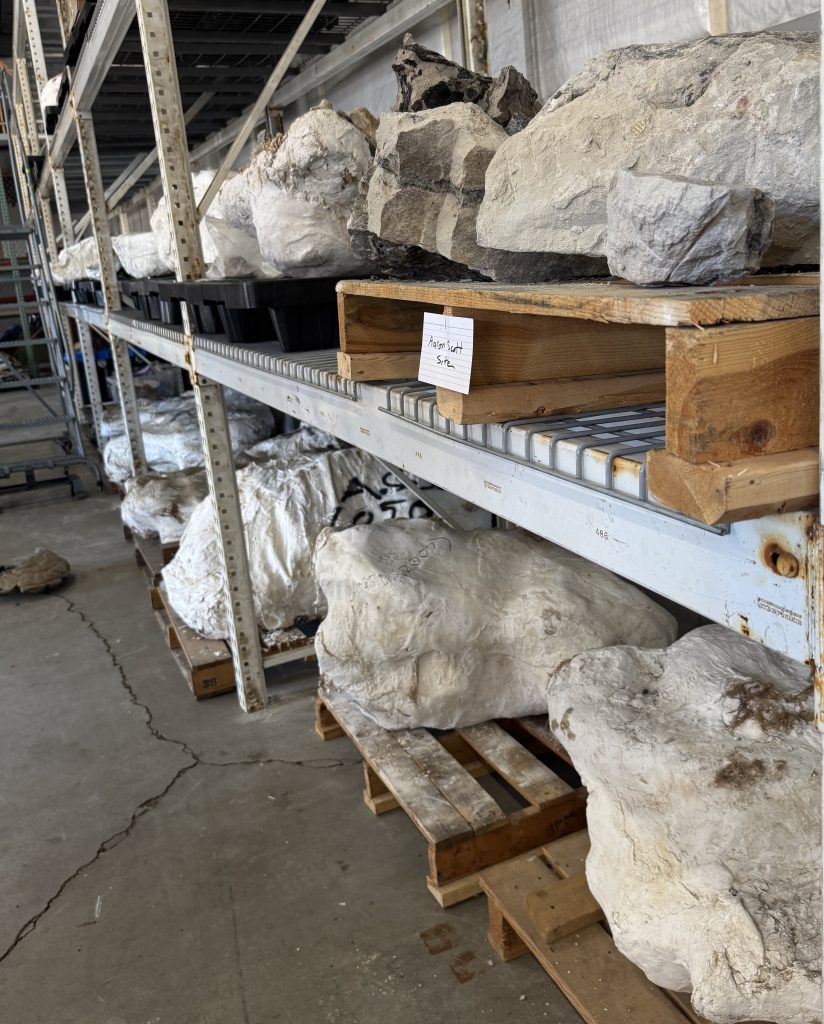
With the fossils exposed, but still surrounded by rock, the teams layered the prehistoric bones with toilet paper and tin foil, then created a protective field jacket of burlap and plaster. Digging underneath the fossil, the crew lopped off the rock like the top of a mushroom, carefully flipping it over to cover and plaster the bottom, encasing the fossil and its surrounding rock. The fossil in its field jacket, sometimes weighing hundreds of pounds, was then transported by hand down the hill and loaded onto a trailer along with the summer’s other finds, ready for transport across the Great Plains and Midwest.
Over the seven-week field season, crews found several hundred fossils, including multiple large sauropod femora from the long-necked herbivores who once thundered across the land. Despite dinosaurs’ massive size, some of the most exciting finds were tiny microfossils and teeth that fit in the palm of one’s hand. Among the discoveries were also several Allosaurus toes and claws.
Further preparation of most of the fossils will take place in CMC’s Paleo Lab in its Museum of Natural History & Science, where guests can see staff and volunteers actively working to remove fossils from their rock matrix.
The collection
CMC’s vertebrate paleontology collection is one of the largest in the country. The collection dates to 1818, when it was established by Cincinnati physician Daniel Drake and the Western Museum Society. Over two centuries, it has grown to over 30,000 fossilized bones, teeth, eggs, footprints and even fecal remains of extinct animals. Materials in the collection prominently include dinosaurs, as well as Pleistocene – Ice Age – mammals from Big Bone Lick, the birthplace of American vertebrate paleontology. While the majority of the vertebrate paleontology collection is maintained at CMC’s collections facility for preservation and research – both by internal and external researchers – significant materials are on display on the museum floor, including the only fully articulated Torvosaurus in the world, on view with several other dinosaurs in the Dinosaur Hall, and a mastodon and accompanying Ice Age fossils in the Ice Age Gallery.
# # #
About Cincinnati Museum Center
Cincinnati Museum Center (CMC) at Union Terminal is a nationally recognized, award-winning institution housed in a National Historic Landmark. CMC is a vital community resource that sparks curiosity, inspiration, epiphany and dialogue. CMC was awarded the 2009 National Medal for Museum and Library Service from the Institute of Museum and Library Services and received accreditation from the American Alliance of Museums in 2012, one of a select few museums in the nation to receive both honors. Organizations within CMC include the Cincinnati History Museum, Museum of Natural History & Science, The Children’s Museum, Robert D. Lindner Family OMNIMAX® Theater, Cincinnati History Library and Archives and the Geier Collections and Research Center. Housed in historic Union Terminal – a National Historic Landmark restored in 2018 and recognized as the nation’s 45th most important building by the American Institute of Architects – CMC welcomes more than 1.8 million visits annually, making it one of the most visited museums in the country. For more information, visit cincymuseum.org.