
Ohio Archaeology Month
By: Tyler Swinney, Manager, NAGPRA and Tribal Liaison
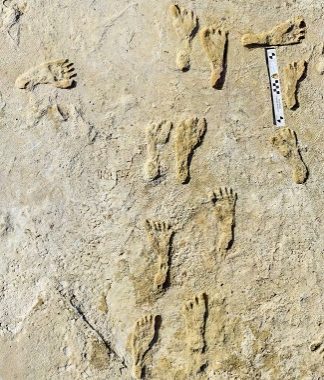
October is Ohio Archaeology Month which nurtures an appreciation for how long people have lived in North American and Ohio’s amazing cultural resources. Currently, the oldest well-supported evidence for human activity in North America are footprints (Figure 1.) from New Mexico’s White Sands National Park. Rarely have archaeologists discovered trace fossils that document lived human experience better than foot impressions, recording the ancient movements of multiple people, delicately preserved in 21 to 22 thousand-year-old sediments.
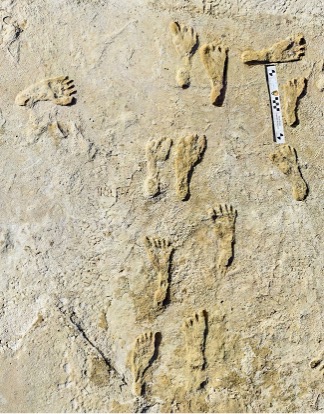
Figure 1. White Sands National Park fossilized footprints. Photo courtesy of the National Park Service.
As you might expect, Ohio’s geological history is dissimilar to New Mexico’s. Pleistocene glacial activity meant that much of Ohio was covered with ice or glacial melt water until about 19,000 years ago while unglaciated regions were characterized by unwelcoming environments. Glaciers completely melted away from Ohio around 12,000 years ago and the state’s generally temperate environment means that only the most durable cultural items usually preserve in the archaeological record.
The oldest evidence for people in Ohio are chipped stone tools called Clovis Points (Figure 2.). Not as delicate an example of human lived experience as footprints, Ohio Clovis Points have an uneven distribution and can also inform human activity. Their discovery locations are tied to ancient migration paths, hunting and foraging behavior of lowland river valleys, and visits to chert quarrying localities like Ohio Flint Ridge. Clovis Points clearly indicate that Native Americans entered Ohio at least 14,000 years ago, while Euro-Americans have been here for about the last 400 years. That means, Ohio’s archaeological history is at least 97.1% Native American-based, with the Late Precontact, Colonial, Removal, and Historic periods accounting for only about 2.9%.
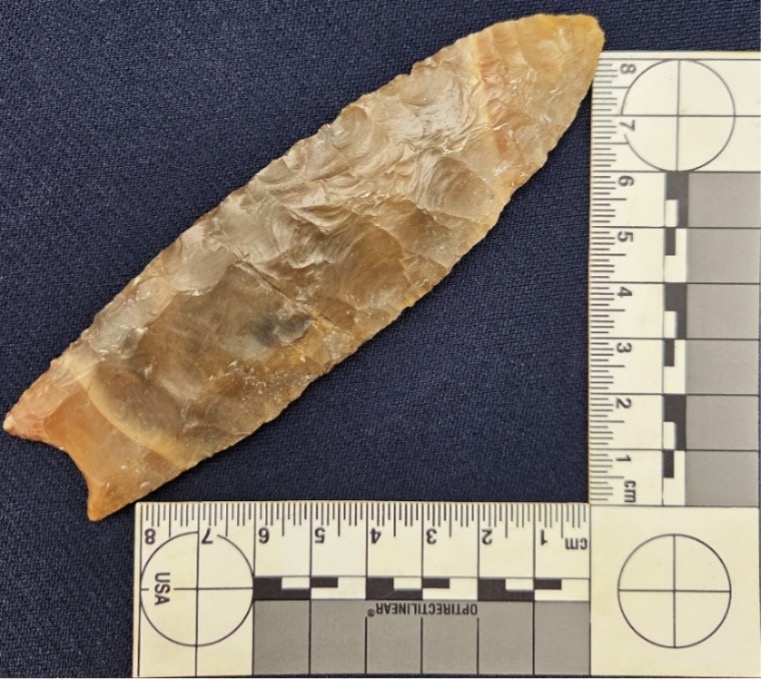
Figure 2. AT402, Clovis Point from Clermont County, Ohio.
Approximately 560 generations, or 14,000 years, is a very long time for people to create amazing cultural resources. Although visible evidence for Ohio’s earliest archaeological time periods (Paleo-Indian and Archaic) is mostly limited to stone tools, the more recent time periods (Woodland and Late Precontact/Fort Ancient) are represented by monumental architecture like Ceremonial Earthworks and Serpent Mound (Figure 3.), the world’s largest animal-shaped earthen construction. These are culturally significant Native American communal and scientific monuments that that are globally appreciated.
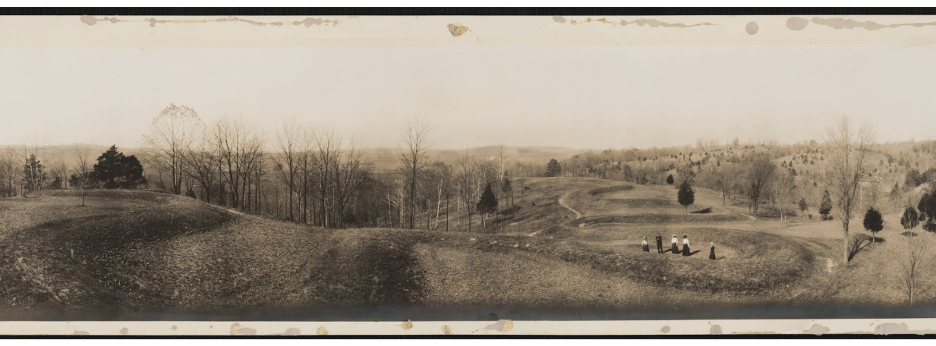
Figure 3. 1910s Serpent Mound Panorama. Courtesy of the Ohio History Connection via Ohio Digital Memory.
Figure 3. 1910s Serpent Mound Panorama. Courtesy of the Ohio History Connection via Ohio Digital Memory.
From the 1500s to the mid-1800s, during the North American fur trade (Figure 4.), the Late Precontact/Early Historic period, is also when Ohio first became an international economic contributor. This is also when important Ohio Tribal histories were first recorded during colonization and westward expansion. SunWatch Village, Great Council State Park, Fort Meigs, and Fort Recovery Museum & Monument are renowned for making this part of Ohio’s archaeological history accessible.
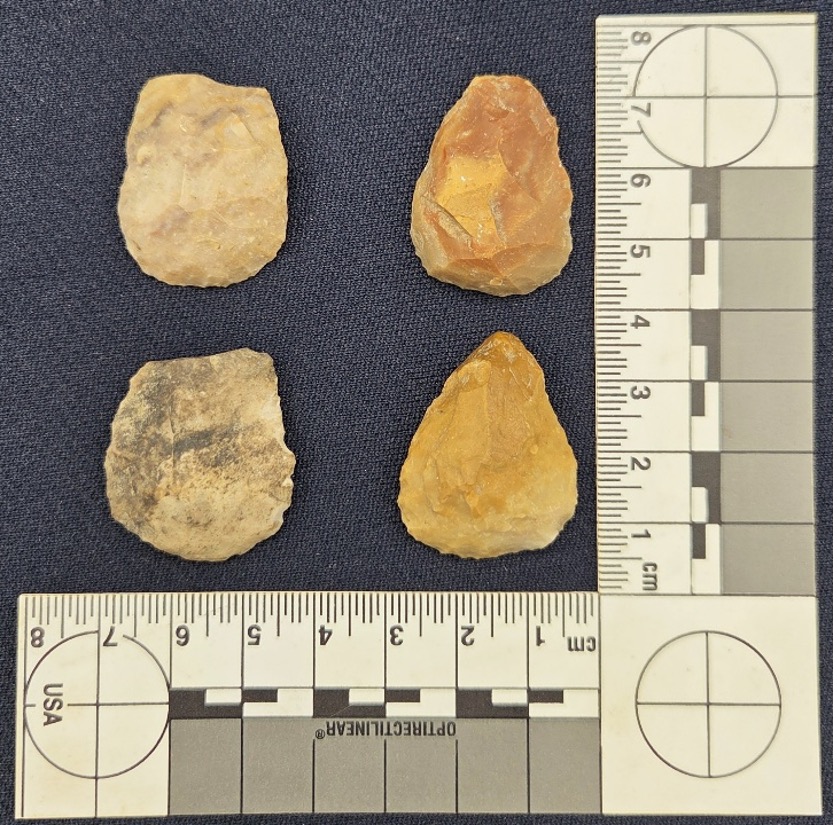
Figure 4. Late Precontact hide scrapers (A96983, A96984, A96985, A96986) from the Carlos P. Long Collection.
So why is Ohio’s archaeological history so interesting? Taking a deeper look past the people who created it, from the St. Lawrence Continental Divide to episodic glaciations, our state’s geology and geography has a lot to do with it.
Geologically, Ohio not only includes abundant resources and fertile lands, but is also defined by a continental divide that drains the northern third of the state toward the Atlantic Ocean (via the eastern Great Lakes and tributaries) and the southern two-thirds to the Gulf of Mexico (via the Ohio River and tributaries).
Geographically, this means that Ohio truly is the “The Heart of it all” and remains easily accessible by interconnected waterways and overland transportation routes that were shaped by glacial advances and recessions over the last 2.6 million years.
Figure 5., from William C. Mill’s Archaeological Atlas of Ohio (1914), shows the distribution of ca. 5,396 Woodland Period (ca. B.C.E. 1000 – 1000 C.E.) earthworks and marked burial mounds. Tribal Nations, like the colonists that subsequently displaced them, recognized the economic and strategic importance of Ohio’s fertile valleys and waterways. You don’t have to look too closely to see a clear a pattern showing the majority of earthworks are concentrated near major waterways and within broad, lowland river valleys.
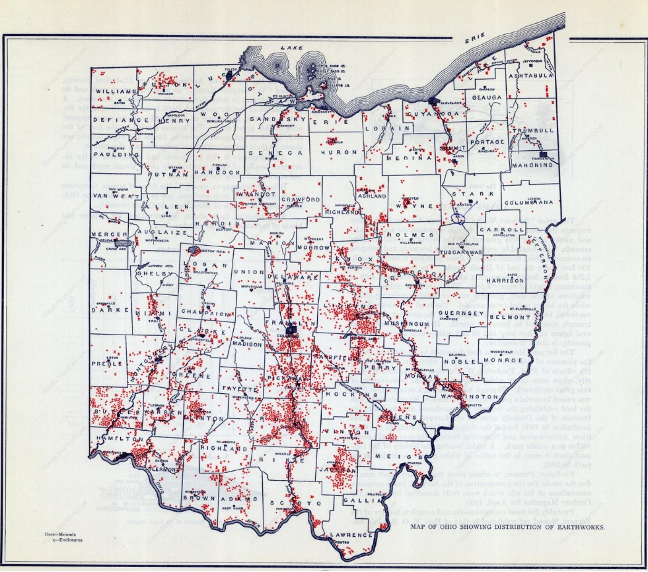
Figure 5: Map of Ohio Showing Distribution of Earthworks. From Archaeological Atlas of Ohio.
The last several years have been exciting from Ohio Cultural and Historic Preservation standpoints. Not only were eight monumental earthwork complexes inscribed as UNESCO World Heritage sites in 2023, but Great Council State Park opened in 2025 as Ohio’s only Native-focused state park. Ball State University Archaeologists and nine Tribal Nation Partners also worked together developing St. Clair’s Defeat Revisited: A New View of the Conflict. This insightful permanent and traveling exhibit explores the most successful defeat of the U.S. military by Native Americans from the perspectives of participant Tribal Nations affiliated with Ohio.
The Myaamia Center, a collaboration between the Miami Tribe of Oklahoma and Miami University, recently celebrated 25 years of work at the university in addition to also commemorating the Fiftieth Anniversary of their remarkable relationship. Logan York, the Tribal Historic Preservation Officer (THPO) for the tribe, also hosted Hopewell Earthworks - Stories Written on The Land, a six-part docuseries exploring the Hopewell Ceremonial Earthworks.
This past summer, the Shawnee Tribe acquired land bordering Serpent Mound to help preserve the site in perpetuity. The tribe also launched the Shawnee Language Immersion Program a few years ago, and even collaborated with video game developers to ensure respectful and accurate representation of the Shawnee in Sid Meier’s Civilization VII.
Considering the last Tribal Nation, Wyandotte Nation, was forcibly removed from Ohio in 1843, it’s easy to fall into the trap that Native American history in Ohio ended with removal. Given the above examples and the many Native contributions to U.S. democracy, agriculture, and medicine; not to mention that we’re surrounded by Native history in the form of US geographic place names, culture, arts, and language, it’s important to remember that Native Americans have never stopped shaping Ohio and American history.
Key Words:
- Cultural resources – anything that represents past or present human activity and holds value for a community, culture, or society.
- Trace fossils – any record of past biological activity or behavior.
- Geological History – the chronological record of Earth’s evolution from formation ca. 4.6 billion years ago to present.
- Pleistocene – the geological time period that lasted from about 2.6 million to 12,000 years ago and commonly known as the “Ice Age”
- Archaeological record – the body of observable evidence left behand past human activity.
- Archaeological history – human activities and events inferred from the archaeological record through the recovery and analysis of material remains created prior to the written historical record.
- Fur trade – the worldwide acquisition and sale of animal fur acquired from eastern North America from the early 1500s through the mid-1800s.
- Continental divide – a natural ridge that separates a continent’s river systems so that they drain into major bodies of water.