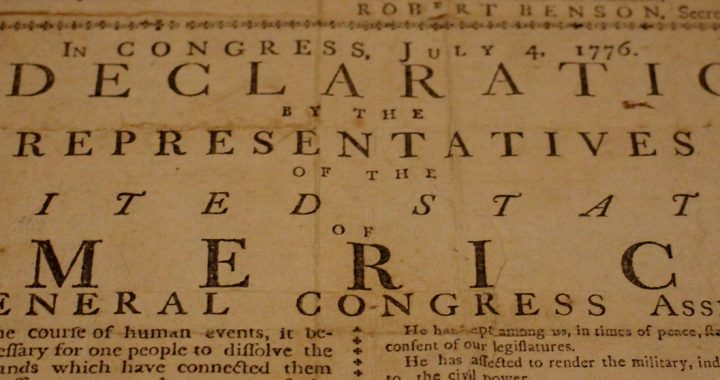
On the evening of July 4th, 1776, Philadelphia printer and engraver John Dunlap, official printer to the Continental Congress, was given an order to print broadside copies of the Declaration of Independence. It is believed that Dunlap likely printed at least 200 copies that night and perhaps more.
[READ MORE]
The Monday Blues
Usually a collections blog would feature a particular object or subject. But I want to take a different approach. Blue is my favorite color, so I’m going to highlight some blue-tiful artifacts in my collection and tell you what I know about them.
[READ MORE]
A Rare Advertising Card and Its Connection to the Titanic
A recently-donated advertising card highlights a successful Cincinnati business from the late 19th century. The rare item also has an unexpected connection to the story of the Titanic!
[READ MORE]
The Role of Women in 20th Century Academic Departments: Meet Elizabeth Dalve from the University of Cincinnati
Despite being a field of such diversity, geology and its disciplines have been traditionally dominated by men. Women made early contributions to the field inside-and-out of academia, but were denied professional positions for decades. While there has been progress made to the position and representation of women in geology, the foundation for this transformation in the geological sciences over the last 200 years began, in part, with women in scientific illustration.
[READ MORE]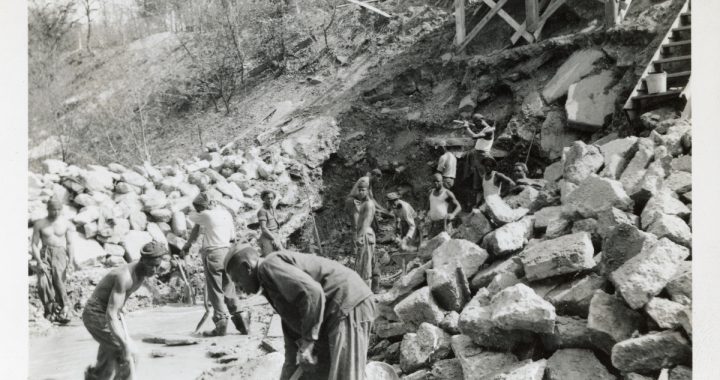
“No Discrimination Shall be Made on Account of Race, Color, and Creed:” – The Civilian Conservation Corps and Cincinnati’s Mt. Airy Forrest
The Great Depression destroyed the American economy in October 1929 leaving many jobless and unable to care themselves and their loved ones. When Franklin Roosevelt took office in early 1933, he sought inventive and productive ways to help regenerate the country.
[READ MORE]
Hopewell Ceremonial Earthworks
What happened here? Place is a powerful concept. Our landscape and environment shape our worldview, and places can hold public memories that bond people to their identities and their past.
[READ MORE]
A Lichen Conservation Story
Can you transplant a lichen from a dead tree to a living one?
[READ MORE]
When Reverend Dr. Martin Luther King Jr. Walked Cincinnati
When thinking of Dr. Martin Luther King Jr., we often imagine protest demonstrations in the South or his iconic “I Have a Dream” speech, not him in Cincinnati, leaving a meaningful mark on our city. Dr. King walked, spoke, strategized, and inspired right here.
[READ MORE]
The Taft Legacy in Letters
Since at least the 1870s the Taft family has supported the institutions that became Cincinnati Museum Center (CMC). In 2025, former Ohio Governor Bob Taft donated letters from the Taft family containing over 400 family letters from the children of William Howard and Nellie Taft.
[READ MORE]
Thomas Jefferson and the Mastodon
When we study history – including the history of science – we use many sources to make sense of what actually happened. One of our country’s Founding Fathers practiced these methods with items that are now part of Cincinnati Museum Center’s collections, and helped change the course of science as a result.
[READ MORE]